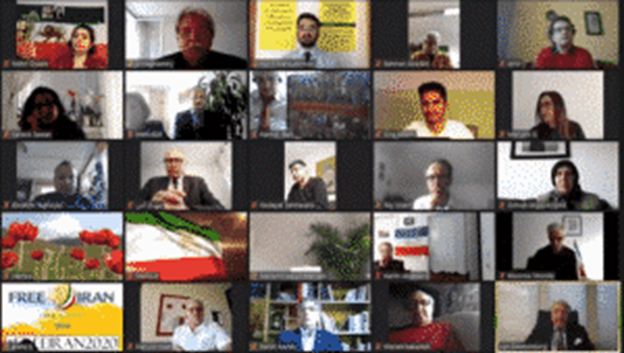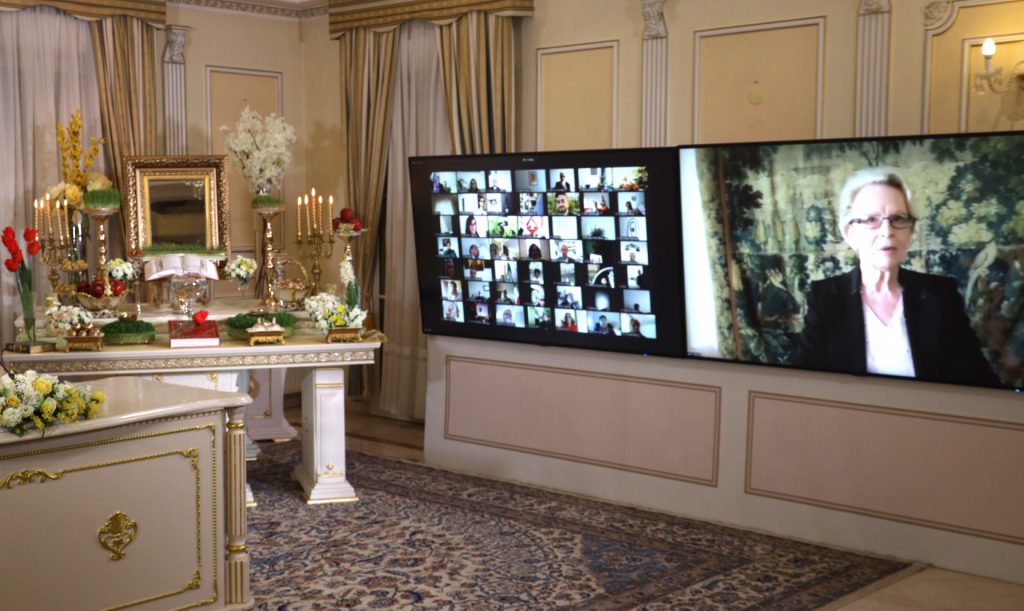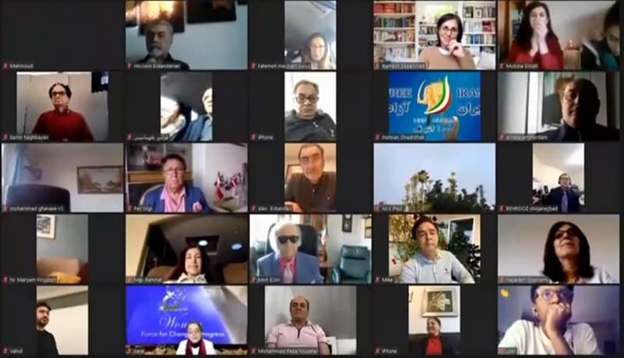
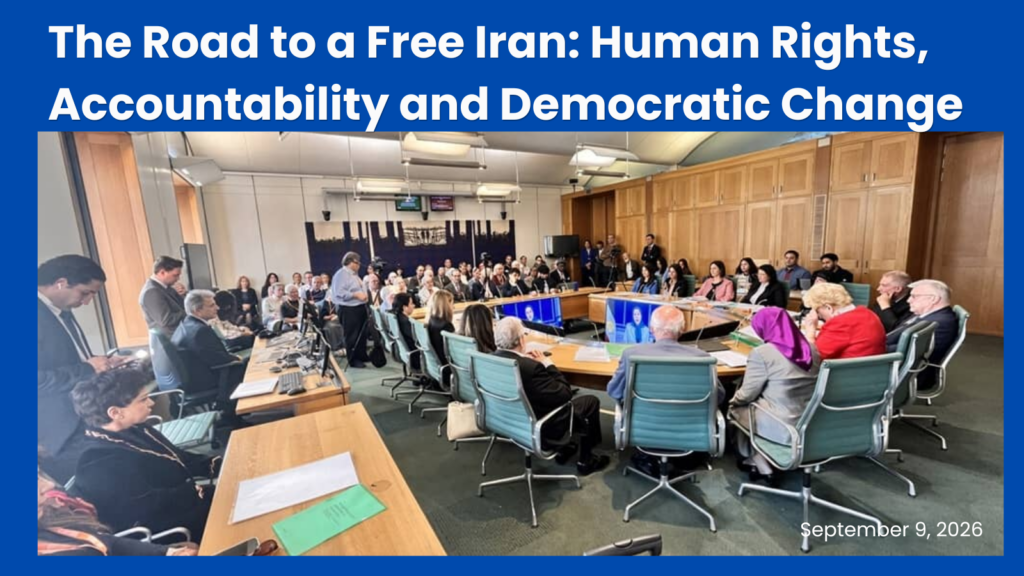
Iranian community in UK organized a parliamentary conference with British MPs, legal experts and academics at Portcullis House, Westminster, on September 9, 2026, entitled, “The Road to a Free Iran: Human Rights, Accountability and Democratic Change.”
The conference focused on the escalating use of executions and repression in Iran, the role of organized resistance inside the country, and the need for an Iranian-led democratic transition. Speakers emphasized that Iran’s future should be determined by the Iranian people and discussed the need for Britain to adopt a policy centered on human rights, accountability and support for democratic forces.
The conference was chaired by Baroness O’Loan DBE, who called for Britain to stand with the Iranian people and strengthen international accountability. She said:
The United Kingdom should stand with the Iranian people and support their right to democratic change.”
She also called for stronger measures against the Iranian regime, including closing its embassy in London and conditioning relations with Tehran on an end to executions and torture and the release of political prisoners.
British MPs: Iran’s Future Must Be Determined by Iranians
Jim Shannon MP, Democratic Unionist Party MP for Strangford, stressed the importance of supporting the organized democratic forces inside Iran. He said:
“Despite the regime’s propaganda, repression, and threats, we know there is an organized democratic alternative led by Madam Maryam Rajavi and the National Council of Resistance of Iran.”
Shannon highlighted the activities of Resistance Units and the continuing imprisonment and execution of PMOI members and protesters. He urged Britain to move beyond expressions of sympathy and said:
“Stand with the Iranian people and their popular resistance. Reject the murderous regime. Recognize the NCRI’s provisional government as a democratic alternative to this regime.”
Sammy Wilson MP, representing East Antrim, spoke about the pressures facing the Iranian regime and the determination of Iranians who continue to resist despite imprisonment, torture and retaliation against their families.
“This is a dangerous illusion. The regime does not represent the Iranian people. It is their oppressor,” Wilson said.
He described the NCRI as offering “a democratic vision for the future” and a framework for a peaceful transition, alongside an organized network of Resistance Units inside Iran. He called on Britain to recognize the NCRI as a democratic alternative and to place human rights at the center of its Iran policy.
Conservative Bob Blackman MP, sent a message that was read by Matthew Goodwin-Freeman. Blackman rejected both war and appeasement as solutions and described the Iranian people and their organized resistance as the driving force for democratic change. He pointed to Resistance Units inside Iran as evidence that the opposition remained “alive, organized, and resilient across Iran.”
Blackman also called for recognition of the NCRI as a provisional authority for democratic transition and support for the Ten-Point Plan, while arguing that Iran’s future should be based on popular sovereignty rather than dynastic restoration.
Lord McCabe placed human rights at the center of British policy toward Iran, describing the protection of ordinary Iranians’ rights as “a moral mission.” He emphasized that executions are used to suppress dissent and argued that:
“Only the Iranian people can determine their own destiny.”
McCabe called for recognition of Iran’s organized democratic opposition and support for a democratic transition.
Robert Ward, a Conservative councillor in Croydon, similarly emphasized that Iran’s political future must be determined by Iranians themselves. He said the Iranian people must decide their future “from start to finish,” without a leader being selected or imposed by foreign governments.
“Decades of appeasement have achieved nothing. Concessions do not moderate this regime,” Ward said, calling for stronger action against the IRGC and for human rights to be placed at the center of British policy.
Iranian Community Voices Bring the Human Cost of Repression to Westminster
The conference also provided a strong platform for Iranian community representatives and younger members of the Iranian diaspora, who connected the broader political discussion to personal experiences of repression, executions and the 1988 massacre.
Dr. Leyla Hannbeck, Chief Executive of the Independent Pharmacies Association, spoke from her own experience of growing up under repression in Iran. She argued that decades of international tolerance had contributed to a culture of impunity and highlighted the need for a political alternative committed to abolishing the death penalty, establishing an independent judiciary and ending discriminatory laws.
She described the NCRI transition framework as providing for:
“a peaceful, orderly, and democratic transfer of power to the Iranian people.”
Hannbeck urged the British government to recognize and engage with the NCRI publicly.
Dolat Nowrouzi, the NCRI representative in the United Kingdom, emphasized that the crisis in Iran cannot be separated from the wider international consequences of the regime’s policies. She rejected expectations that Tehran would voluntarily moderate its conduct.
“The war is not an option,” Nowrouzi said. “It may weaken, but it can’t change the regime. It needs to be changed by Iranian people.”
She called for an end to appeasement and greater international support for the Iranian people’s organized democratic resistance.
Dr. Elaheh Zabihi, a University of London lecturer speaking on behalf of an international academic community, highlighted the experiences of Iranian intellectuals who had faced repression under both the monarchy and the clerical regime. She called for greater international attention to prisoners and executions and said academics supported the organized resistance and its proposed democratic framework.
She also called for international access to Iranian prisons and detention centers, an end to sham trials and the unconditional release of prisoners held for exercising fundamental rights.
A New Generation Keeps the Memory of Executions Alive
The voices of younger Iranian community members gave particular emphasis to the continuing human cost of repression.
Rosa Zare, a 24-year-old doctoral student in international politics, spoke about her aunt, who was executed at the age of 21 during the 1988 massacre. She explained that this history makes human rights “not simply an academic responsibility” for her.
Referring to the ongoing No to Executions Tuesdays campaign, she highlighted the determination of prisoners who have continued hunger strikes across dozens of Iranian prisons.
“We cannot allow executions to become statistics,” Zare said. “Behind every number is a person, a family, a mother, a father, a sister, a brother, a friend.”
She stressed that international solidarity must go beyond statements, saying that for prisoners facing execution, “it has to mean something.”
Amir-Hossein Olyaee, a 22-year-old biomedical engineering master’s student, also connected the issue of executions to his own family. He spoke of an uncle who was executed after security agents came to his home.
“His story is one of countless Iranian lives destroyed by a regime that uses execution, torture, and fear to suppress opposition,” Olyaee said.
He argued that Iran’s future must be determined by its people and called on Britain to make human rights and accountability central to its policy toward Iran.
Legal and Academic Voices Call for Accountability
Professor Sara Chandler KC, Secretary of the Human Rights Committee of the Federation of European Bar Associations, addressed executions, torture, judicial independence and the persecution of lawyers and political prisoners.
“We are clear and have known for many years that the organized resistance of the PMOI aims to establish a democratic republic based on elections,” she said.
Chandler explained that the proposed transition framework seeks to prevent a political vacuum while preparing for elections to a constituent and legislative assembly. She also highlighted the role of women and respect for Iran’s ethnic, linguistic and cultural diversity.
Dr. Jocelyn Scott, a former judge, described executions as an instrument of repression and intimidation. She placed Iran’s current crisis in a longer historical context, saying:
“In 1979 a monarchical dictatorship, the Shah’s dictatorship, was replaced by a dictatorship of a theocracy. Democracy must now prevail.”
Scott argued that neither military intervention nor concessions to Tehran would resolve the political crisis and called instead for recognition of the Iranian people’s right to resist repression.
Dr. Caroline Bennett, an academic specializing in anthropology, human rights, genocide and atrocity crimes, focused on the international dimension of impunity. She argued that decades of accommodation had contributed to the failure to hold perpetrators accountable.
“We haven’t forgotten you. We won’t forget you,” Bennett told Iranians affected by arbitrary detention, torture and killings.
Maryam Rajavi: Support the Iranian People
In a video message, Mrs. Maryam Rajavi, President-elect of the National Council of Resistance of Iran, addressed the conference’s central themes, calling for British policy to support the Iranian people’s demand for a free and democratic republic.
She urged the international community to move beyond both war and appeasement and to make human rights and accountability central to its relations with Tehran.
“Now, it is time for the world to stand with the people of Iran.”
Rajavi also called for international action against those responsible for executions and mass killings and for diplomatic and commercial relations with Tehran to be conditioned on an end to executions.
Community Engagement and a Democratic Future
Matthew Goodwin-Freeman, Harrow councillor and senior parliamentary assistant to Bob Blackman, emphasized the role of parliamentarians, councillors, activists and members of the Iranian community in challenging disinformation and keeping Iran’s human-rights crisis on the political agenda.
“We’re not going to give up,” he said, describing the shared commitment of those supporting Iranian democratic aspirations as one based on “freedom, fairness, democracy.”
The conference brought together political representatives, legal experts, academics and members of the Iranian diaspora around a common focus on the human-rights situation in Iran and the question of democratic transition. Across the interventions, speakers repeatedly emphasized the importance of Iranian agency and the need for international policies that address executions, political repression and impunity while supporting the Iranian people’s right to determine their own future.