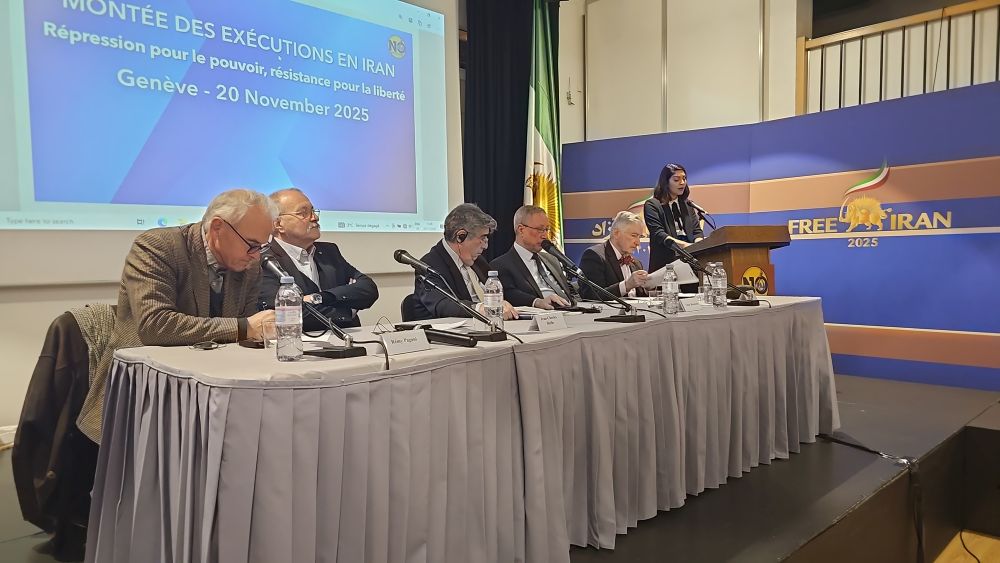
A high-level international conference held in Geneva on November 20, 2025, issued an urgent call for the United Nations Security Council to take up Iran’s human rights dossier. Convened amid a sharp rise in state-sanctioned executions and following a landmark UN Third Committee resolution, the gathering brought together European lawmakers, former UN rapporteurs, legal experts, and Iranian activists. Speakers denounced Tehran’s “killing machine” .
Former UN Special Rapporteur Javaid Rehman described 2025 as the most violent year since 1988. He cited over 1,500 executions and highlighted the July 27 execution of political prisoners Mehdi Hasani and Behrouz Hassani. He condemned Tehran’s destruction of evidence, noting the conversion of the 1988 massacre’s mass grave into a parking lot.
Rehman urged the creation of an international accountability mechanism, declaring that the regime has “weaponized the death penalty” to eliminate dissent.
Member of the Grand Council of Geneva Jean-Charles Rielle emphasized Geneva’s symbolic role in defending human rights. He condemned the executions as political terror and called for diplomatic pressure, sanctions, and an immediate UN mission to inspect Iranian prisons, especially those holding women.
Former UN Independent Expert Alfred de Zayas outlined legal avenues to bypass geopolitical paralysis. He argued that Iran’s ongoing crimes qualify for prosecution by the International Criminal Court (ICC) under Article 7 and strongly advocated using universal jurisdiction. Winning the “information war,” he said, is essential to counter Tehran’s narrative.
Tahar Boumedra, former head of UNAMI’s Human Rights Office, hailed the UN Third Committee’s new resolution for naming the IRGC and judiciary as perpetrators. He warned that Khomeini’s 1988 fatwa remains in force and stressed the need to identify perpetrators through universal jurisdiction mechanisms.
Former Geneva Mayor Rémy Pagani compared Iran’s execution apparatus to Nazi tactics, calling the death penalty a tool of political control. He emphasized civil society’s duty to break the silence surrounding political prisoners and warned of the regime’s expansionist ambitions.
Former UN Working Group Chair Jeremy Sarkin noted that while 130 nations support a moratorium on executions, Iran has intensified them. He described capital punishment in Iran as “state violence” and defined enforced disappearance as a continuous crime—one Iran continues through concealing 1988 burial sites.
Engineer and activist Hossein Imani Nejad argued that the regime fears a popular uprising backed by organized resistance more than war or sanctions. He said the 1,500 executions in 2025 represent the regime’s “last weapon” to maintain power and accused Tehran of masking political executions as drug or espionage cases.