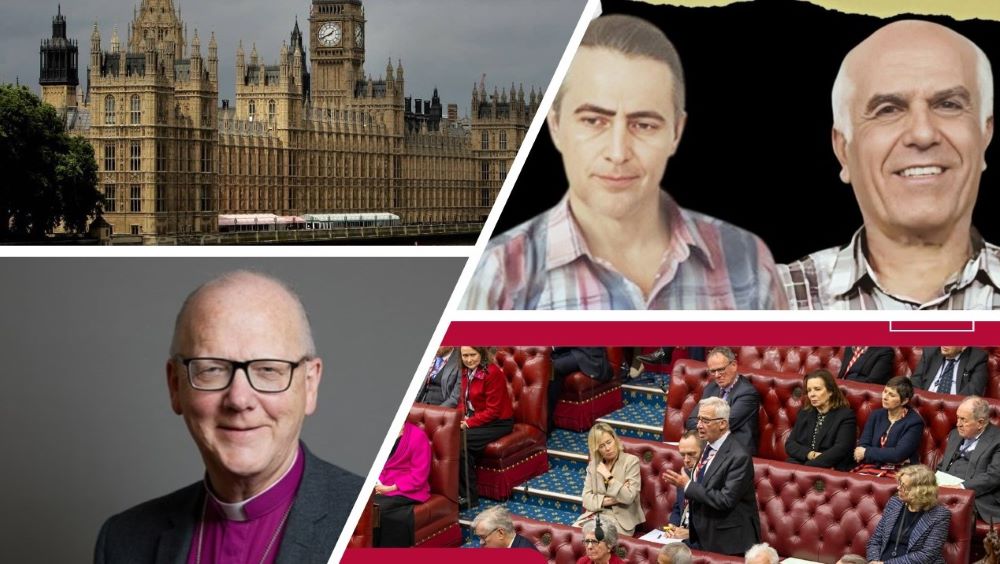
During a parliamentary debate on February 27, 2025, members of the UK House of Lords condemned Iran’s escalating human rights violations, expressing deep concern over the detention of British and dual nationals, the persecution of religious minorities, and the increasing use of the death penalty as a tool of political repression.
The Bishop of St Albans specifically highlighted the cases of political prisoners Behrouz Ehsani and Mehdi Hassani, who are at imminent risk of execution on charges of “armed rebellion against the state.” Calling for immediate intervention, he urged the UK government to take all necessary steps to prevent their executions and push back against Iran’s growing reliance on capital punishment, describing the situation as “truly harrowing.”
Lawmakers also denounced the systematic persecution of religious minorities. The Bishop of Chelmsford emphasized that “religious freedom is severely restricted for everyone except Persian-speaking Shias” and underscored the plight of Christian converts from Islam, who frequently face arrest, imprisonment, and fabricated charges of acting against national security.
Another key focus of the debate was Iran’s continued detention of British and dual nationals. Parliamentarians noted that since 2010, over 60 foreign nationals—including 16 with British or dual nationality—have been imprisoned in Iran, often on baseless charges and without fair trials, used as political bargaining chips.
The Bishop of Chelmsford called for stronger international pressure, stating, “Let us call this situation out for what it is. Other countries, such as France, are willing to do so. The more European and other nations speak with one voice, the greater the pressure on Iran to change its approach.”
Lawmakers also pushed for tougher measures to counter state hostage-taking, referencing a Canadian-led initiative against arbitrary detention that the UK joined in 2021. Baroness Northover questioned the UK’s approach, asking, “Other countries secure the release of their citizens differently. Will the government review its strategy?”
The Bishop of St Albans further highlighted Iran’s alarming execution rate, noting that at least 901 people were executed in 2024, including 40 in a single week in December. He warned that Iran’s military activities and nuclear ambitions posed a growing threat, stating, “An increasingly desperate Iranian regime is an increasingly dangerous one.” He also pressed for firmer action against Iran’s security forces, asking, “The Revolutionary Guard plays a key role in hostage-taking—what is the government’s current stance on them?”
Responding to these concerns, Lord Collins of Highbury, the UK’s Under-Secretary of State for Foreign, Commonwealth, and Development Affairs, reaffirmed the government’s commitment to holding Iran accountable for its human rights abuses. He noted that the UK has sanctioned 94 Iranian individuals and entities since 2022 and reiterated the government’s advisory against all travel to Iran, warning that “holding a British passport or having connections to the UK can be reason enough for the Iranian authorities to detain someone.”
As Iran’s human rights crisis deepens, British lawmakers continue to call for stronger international coordination to counter Iran’s hostage diplomacy, mass executions, and religious persecution. The debate underscored growing demands for urgent action to prevent further abuses and protect those at risk.