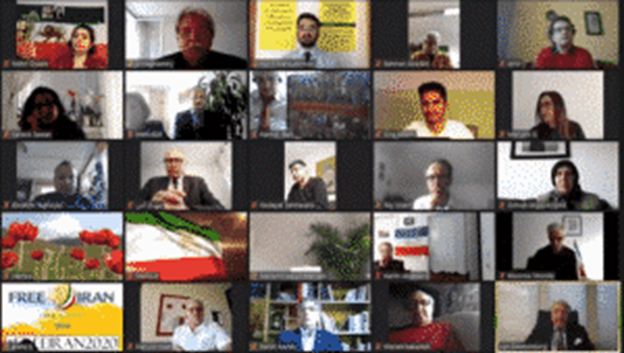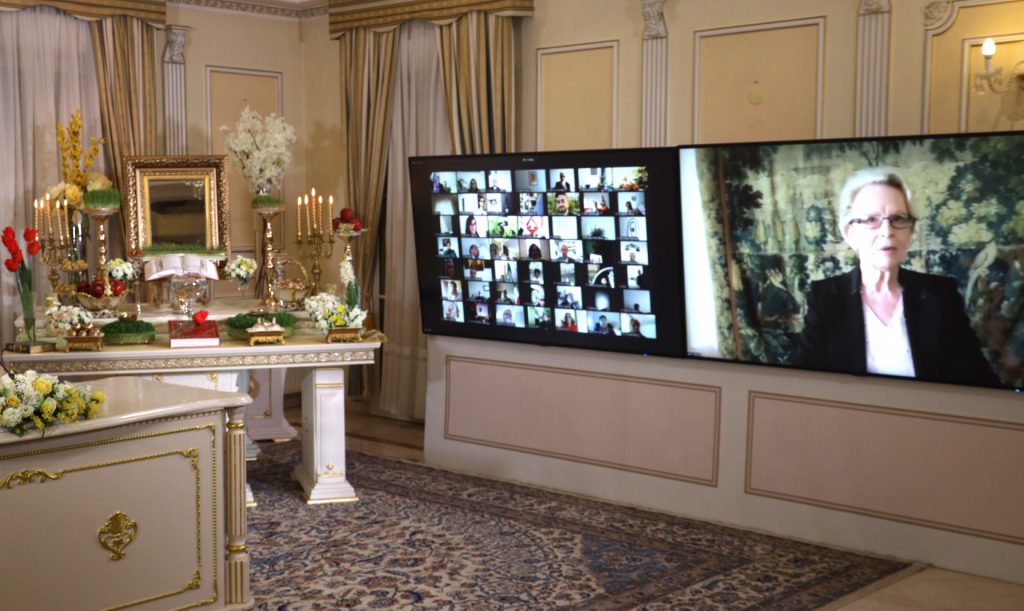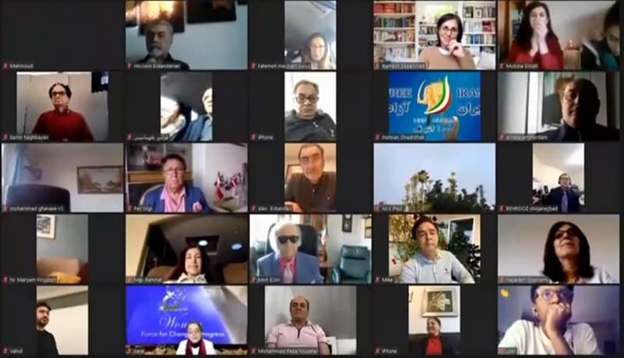
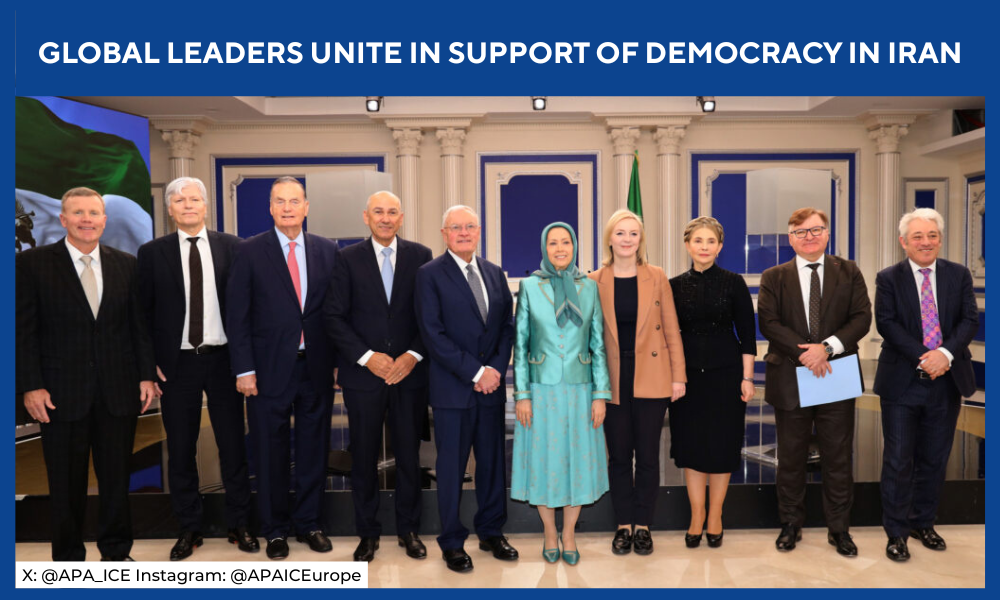
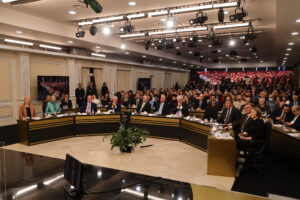
Prominent leaders gathered in Paris on January 11, 2025, for an international conference emphasizing the urgency of a global policy shift toward the Iranian regime. The event brought together distinguished political and military figures who highlighted the Iranian Resistance as a credible democratic alternative to the ruling theocracy.
Speakers included Maryam Rajavi, President-elect of the National Council of Resistance of Iran (NCRI); Gen. James Jones, former U.S. National Security Advisor; Liz Truss, former UK Prime Minister; John Bercow, former Speaker of the UK Parliament; Janez Janša, former Prime Minister of Slovenia; Yulia Tymoshenko, former Prime Minister of Ukraine; Gen. Tod Wolters, former NATO Commander and U.S. Forces in Europe Commander; David Jones, former UK Minister; and Gen. Keith Kellogg, former National Security Advisor to U.S. Vice President Mike Pence. Additional contributions came from Ola Elvestuen, former Norwegian Minister of Climate and Environment.
Maryam Rajavi addressed the regime’s vulnerabilities, stating, “The boycott of the 2024 elections and the fall of the Syrian dictatorship demonstrate that the Iranian regime is on the brink of collapse.” Highlighting economic crises, regional defeats, and the growing activities of Resistance Units, she added, “The Resistance Units in Tehran and other cities are advancing the great task of preparing for an organized uprising.” Rajavi called on Western governments to abandon appeasement, asserting, “The recognition of the Iranian Resistance is a necessary part of a firm policy against the mullahs’ regime.”
Gen. James Jones characterized 2024 as “catastrophic for the Iranian regime,” citing Tehran’s strategic failures, including the “fall of Bashar al-Assad” and “Hezbollah’s near-collapse.” Praising MEK-affiliated Resistance Units, he remarked, “These brave men and women remind us that the spirit of resistance in Iran is alive.” Jones urged stronger sanctions and added, “We must recognize the NCRI as the legitimate voice of the Iranian people.”
Liz Truss criticized appeasement policies, declaring, “Appeasement only strengthened the regime.” She warned, “Iran is on the verge of acquiring a nuclear weapon, and this poses an existential threat to global peace.” Advocating for a firm stance, she called for “maximum pressure sanctions, rigorous enforcement, and support for the Iranian Resistance,” emphasizing that “the NCRI offers a clear and democratic vision for Iran’s future.”
John Bercow praised the NCRI, stating, “Mrs. Rajavi and the NCRI are the embodiment of vision, courage, and leadership.” Referencing the widespread boycott of the 2024 elections, he noted, “Millions of Iranians rejecting the regime at the ballot box demonstrate its unpopularity.” He described the Resistance Units as “interwoven with Iranian society” and hailed the NCRI’s plan as “a roadmap for a peaceful transition to democracy.”
Gen. Keith Kellogg declared 2025 a “year of hope, action, and change,” noting, “The regime in Iran is weaker and more vulnerable than it has been in decades. It should not be feared but challenged.” Criticizing past appeasement, he identified “President Trump’s withdrawal from the Iran nuclear deal” as a pivotal moment. Endorsing the NCRI’s Ten-Point Plan, he called it “a clear transitional path to a friendly, stable, and non-nuclear Iran.”
Janez Janša emphasized the need to recognize the NCRI, stating, “The people of Iran deserve democracy, freedom, and the protection of human rights.” Rejecting past engagement strategies, he insisted, “It is time to transition from engagement to firmness.” He called for “sanctions enforcement and the designation of the IRGC as a terrorist organization.”
Yulia Tymoshenko likened Iran’s freedom movement to Ukraine’s fight against tyranny, asserting, “The Iranian regime is one of the gravest threats to global stability.” She highlighted the role of Iranian women, describing them as “the heart of the movement for change.” Tymoshenko urged decisive international action, stating, “The Iranian people are not asking for military intervention but for moral and political support.”
Gen. Tod Wolters described 2025 as a “transformative year for Iran.” Praising the Iranian Resistance, he said, “For over four decades, you have given your blood, sweat, and tears to correct the nefariousness of the regime.” Highlighting the regime’s weaknesses, he added, “The conditions are correct on the ground and strategically.”
David Jones referred to Assad’s overthrow as “a pivotal loss” for Tehran, observing, “The collapse of the IRGC’s intervention in Syria highlights the vulnerability of the regime.” Condemning the regime’s brutality, he cited “nearly 1,000 executions in 2024 under President Masoud Pezeshkian.”
Ola Elvestuen pointed to Tehran’s “deliberate defamation campaign against the NCRI” as evidence of its fear of organized resistance. He warned, “The regime wants to paint a picture of disunity to confuse parliamentarians and the public.” Advocating for global recognition of the NCRI, he stated, “Sanctions alone are not enough. The international community must recognize and engage with the true agents of change—the Iranian people and their organized resistance.”
The conference concluded with a united call for firm international policies against the Iranian regime and unwavering support for a democratic transition led by the Iranian Resistance.