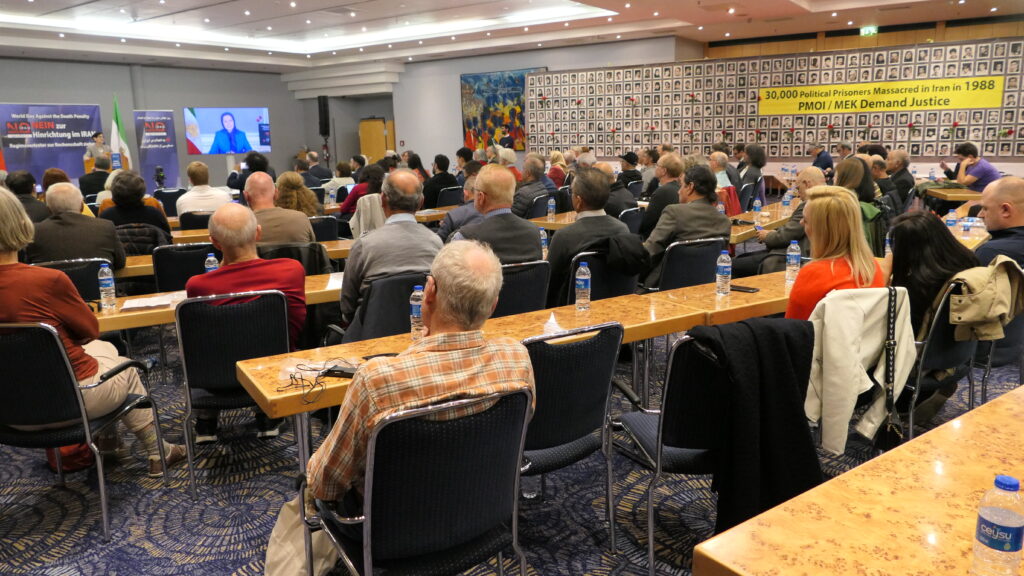
Berlin – 10 October 2024 – At a gathering on the World Day against the Death Penalty, prominent German politicians, legal and human rights experts came together to condemn the Iranian regime for its excessive use of the death penalty and to express their support for fundamental change in Iran. Among the prominent speakers at the conference were Prof. Dr. Rita Süssmuth, former President of the Bundestag; Member of the Bundestag Thomas Lutze (SPD), Dr. Hans-Ulrich Seidt, Ambassador (ret.), former Chief of Inspection of the Federal Foreign Office; Superintendent Thomas Harms, representative of the Ev. Church of Berlin-Brandenburg-Silesian Upper Lusatia (EKBO); Leo Dautzenberg, Chairman of the German Solidarity Committee for a Free Iran (DSFI), former Member of the German Bundestag and Martin Patzelt, former Lord Mayor, former member of the Human Rights Committee of the Bundestag, as well as other respected politicians and human rights activists.
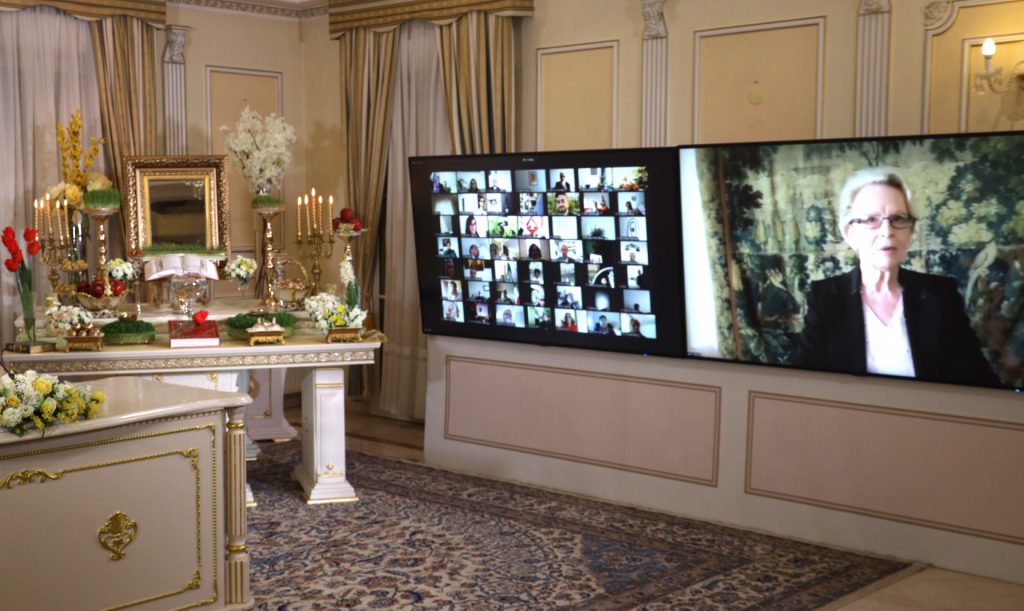
Mrs. Maryam Rajavi, the President-elect of the NCRI, spoke via video at the Berlin conference and honored the courageous women and men executed by the mullahs’ regime. She stressed that these people have paid the highest price for freedom and human rights. Rajavi condemned the increase in executions and criticized the impunity that Western governments grant to the Iranian regime.
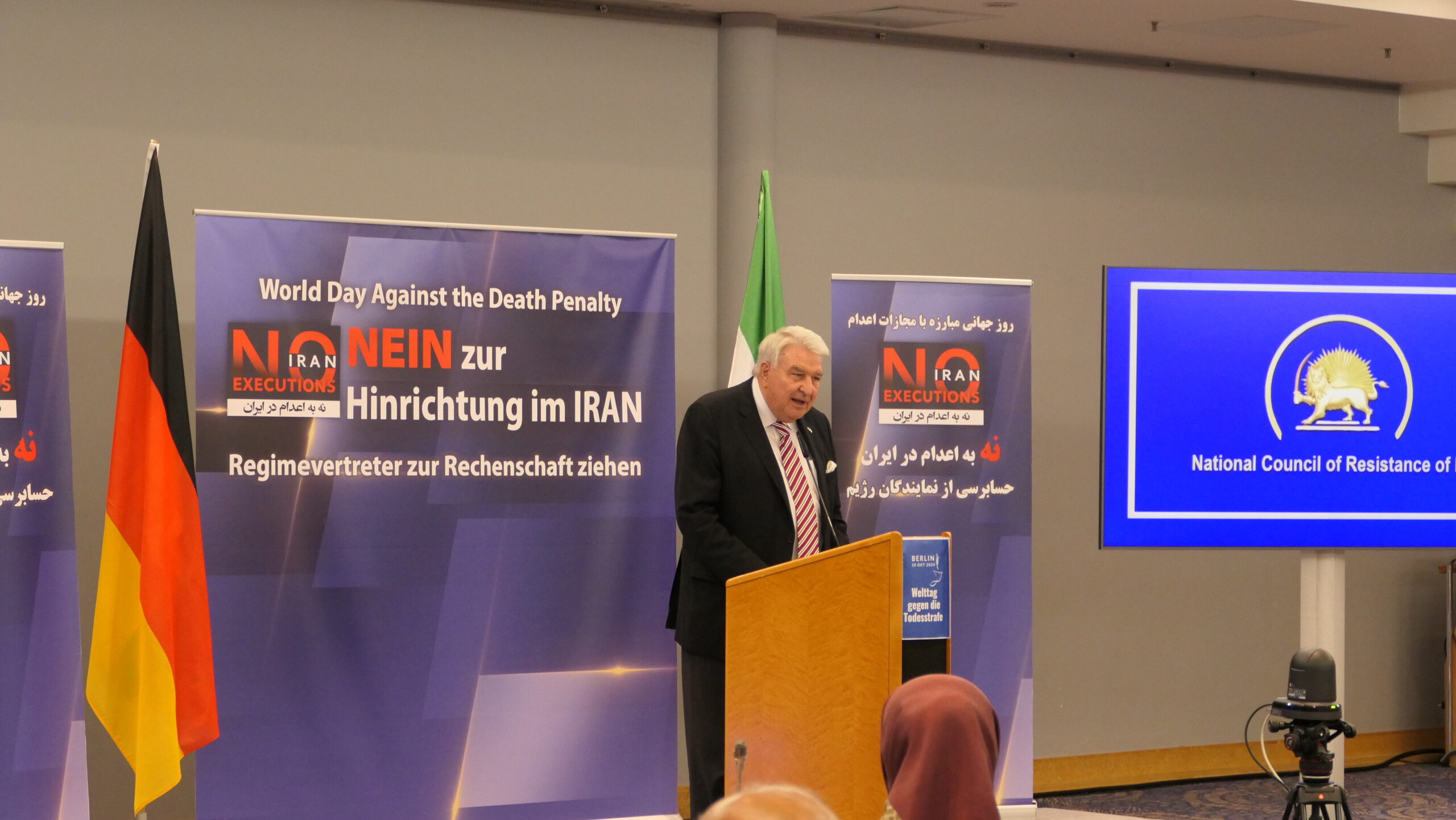
In his opening speech, Leo Dautzenberg, Chairman of the DSFI and former member of the Bundestag, emphasized the importance of the international commitment against the death penalty in Iran. He pointed out that the Iranian regime is responsible for almost three-quarters of all executions worldwide. Dautzenberg emphasized the importance of Professor Javaid Rehman’s report, which supports the indictment of the Iranian leadership for crimes against humanity and genocide.
Dautzenberg explained that the greatest enemy of the Iranian people is their own regime, which fears the organized opposition. He called on the international community, in particular Europe, to take decisive action against the crimes of the Iranian regime and to support the democratic alternative.
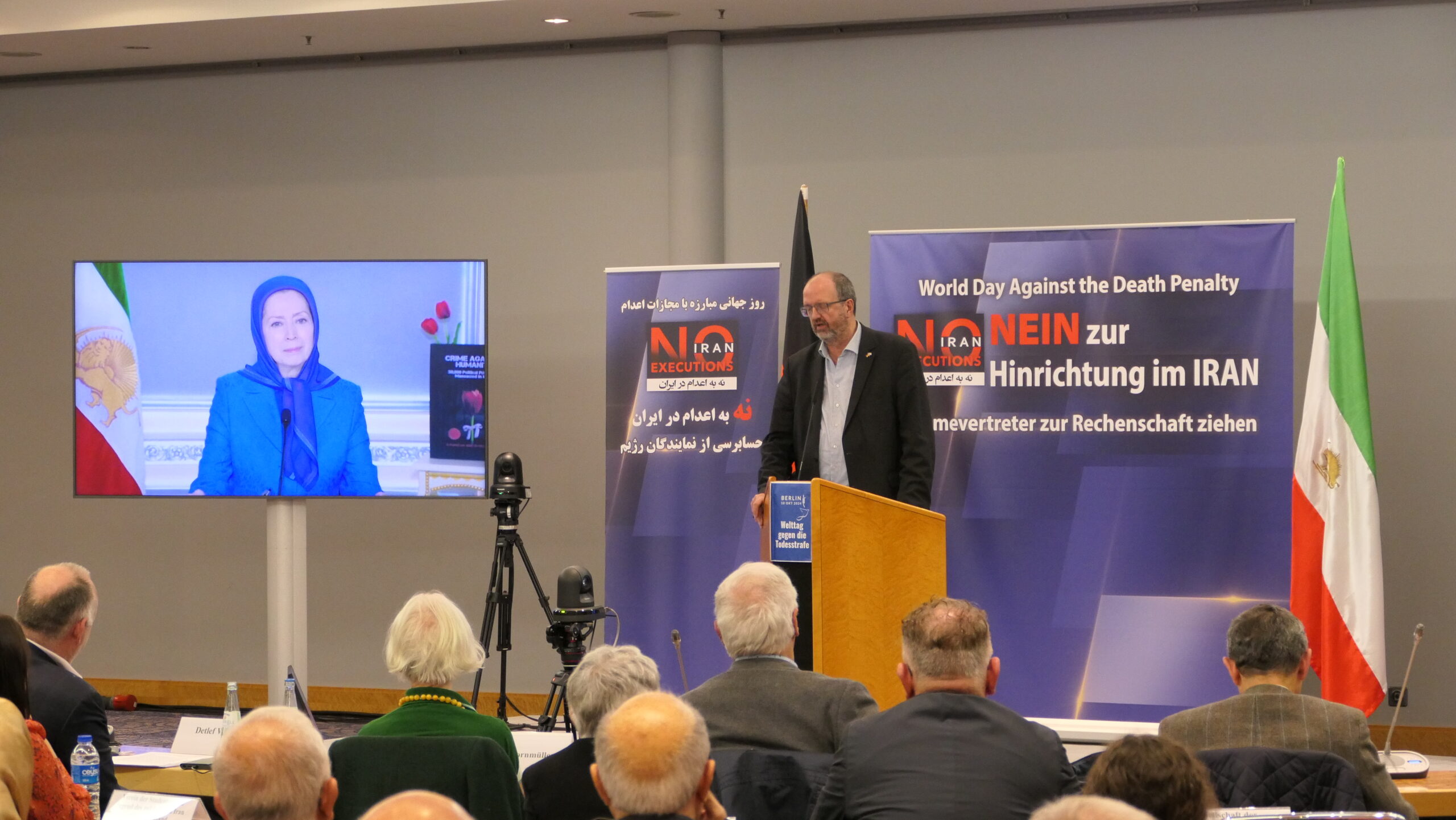
Member of the Bundestag Thomas Lutze (SPD), who has been closely following developments in Iran for years, made it clear in his speech that the severity of human rights violations in Germany is often not sufficiently perceived. “The dimension of what is happening in Iran has not yet reached the German public as it should be,” Lutze stressed. He also spoke about the direct link between Iran and the recent conflicts in the Middle East: “There is no doubt that Iran massively supports Hamas, Hezbollah and other terrorist groups.”
Lutze called for stronger action against the death penalty and emphasized Germany’s moral responsibility: “The death penalty must be abolished everywhere, and first and foremost in Iran.” He praised the efforts of the event participants: “I will continue to work to ensure that the message of this resistance, which is so clear here, is heard much more strongly in the Bundestag. We must support the people of Iran in deciding for themselves how they want to live, what political system they want, and what religion they want to practice.”
Former Bundestag President Prof. Dr. Rita Süssmuth emphasized the importance of perseverance in the fight against the Iranian regime. “I have learned from the people of Iran that the worst thing you can do is to give up something you are convinced of,” she said. Süssmuth underlined the need to maintain pressure on the regime while maintaining hope: “We must believe that the day will come when the Iranians will be liberated. The fight may seem hopeless, but it has always been worth continuing.”
She praised the courage of the Iranian opposition and its supporters around the world and called on the international community to step up resistance to the regime.
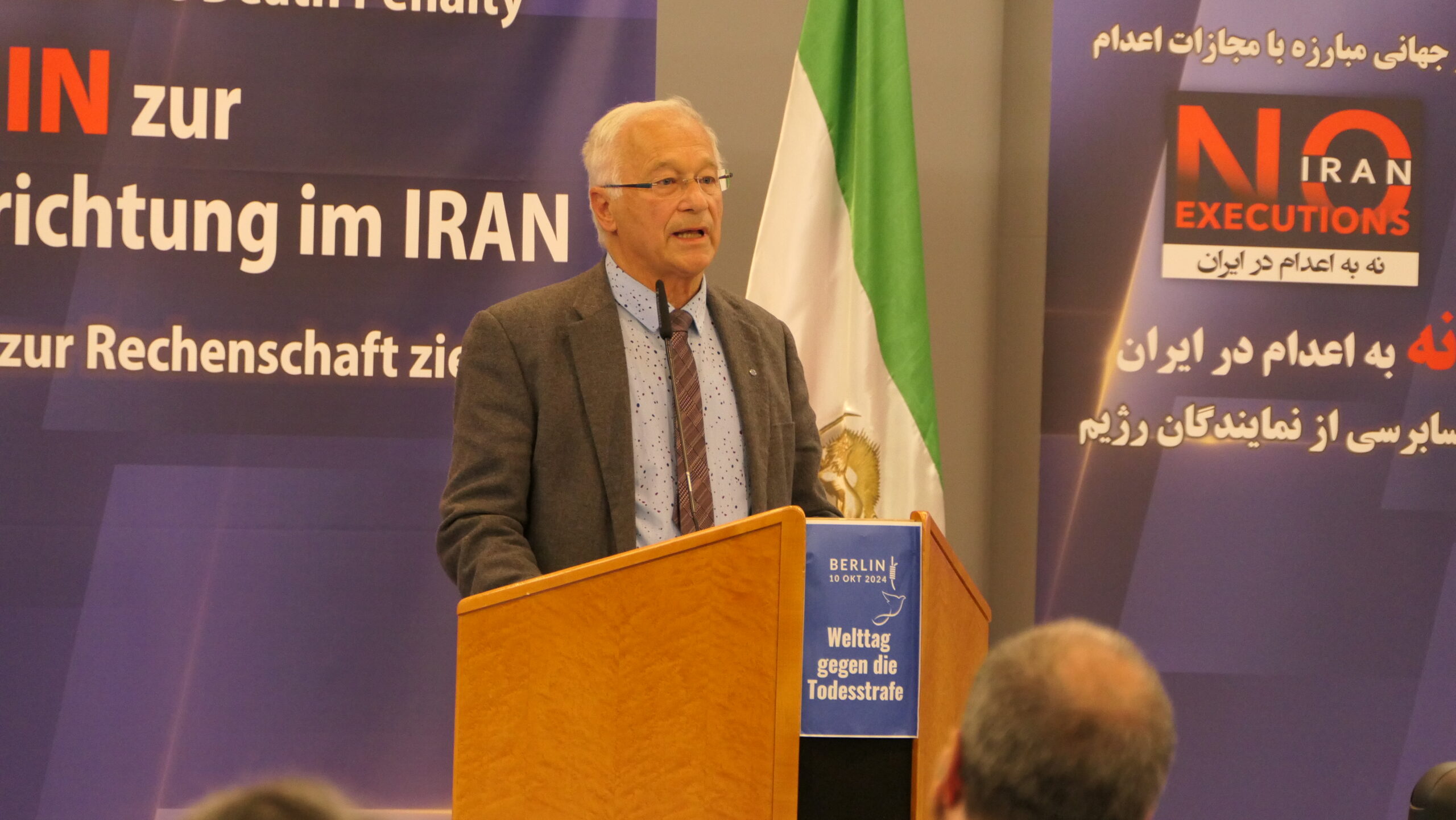
Martin Patzelt (CDU), who was a member of the Bundestag’s Human Rights Committee for two periods until 2021, said: “I have been following the political situation in Iran for many years. The Iranian people have a strong cultural tradition. The struggle for freedom in Iran has a history of more than 100 years. The People’s Mojahedin organization of Iran (PMOI) has been fighting for freedom for 60 years against two dictatorships, that of the Shah and the clergy. The regime and the remnants of the former dictatorship – Shah – have tried to create false alternatives, but have failed and will continue to fail. The Iranian people are determined to overthrow this regime and establish a republic based on democratic values.
Patzelt recalled the massacres of 1988, in which 30,000 political prisoners, 90% of whom were members of the PMOI, were brutally executed.” He strongly condemned the current crimes of the Iranian regime and pointed out that the smear campaigns against the PMOI were a strategy to discredit the legitimate opposition.
In his speech, Detlef Wagner, Deputy District Mayor of Berlin, emphasized the importance of the National Council of Resistance of Iran (NCRI) and emphasized the need for regime change in Iran. “All the ugly things that we are seeing right now, what is happening in the region around Iran and in Iran, is terrible for us every time we see it. And one thing is certain, if there is no regime change in Iran, then we will have to continue to see these images,” Wagner said and stressed: “Only united resistance and tireless commitment to human rights can bring about change in Iran.”
Ambassador (ret.) In his speech, Dr. Hans-Ulrich Seidt, former Chief Inspector of the Federal Foreign Office, gave a historical overview of Iran’s political development. He stressed that repeated external interventions often lead to authoritarian systems in Iran. According to Seidt, the Iranian people today are looking for a self-determined new order and have missed many opportunities. Seidt emphasized the concentration of power in the supreme leader and the dominant role of the Revolutionary Guards (IRGC). He stressed the importance of international efforts to abolish the death penalty and recalled that this has been a central concern of German foreign policy for decades. Finally, he called for realistic diplomacy that prioritizes justice and human rights in Iran. He spoke out in favor of the terrorist listing of the IRGC.
Superintendent Thomas Harms, representative of the Evangelical Church EKBO, spoke about the brutal practice of the “death penalty” in Iran. In addition to the official wave of executions, according to Harms, there is also an unofficial extermination strategy, in which the regime deliberately kills resistance fighters. Harms sharply condemned the Iranian regime: “Sin is not to cross a red light, but is alienation from God. And what the mullahs are doing is pure sin, it is also to distance themselves from their Abramite God, because they supposedly actually take God’s actions into their own hands.” He particularly emphasized the cruel executions of young women and men, which he described as terror. Despite this darkness, it is important to continue to spread hope, says Harms.
Katrin Bornmüller, Honorary Chairwoman of the International Society for Human Rights (ISHR), denounced the high number of executions. “The Iranian regime holds the world record for executions in relation to the country’s population,” said Bornmüller, mentioning that more than 250 people have already been executed since the new Iranian president took office. She recalled that these are not just numbers, “We are talking about human lives, people who are full of love and life just like us.”
“The unimaginable scale of the mullahs’ crimes and the admirable level of steadfastness of those who were willing to take on all this pain and suffering to realize freedom is impressive,” she said. Bornmüller concluded her speech with an appeal to German politicians to make a clear commitment to the future of a free Iran.
concluded her speech with an appeal to German politicians to make a clear commitment to the future of a free Iran.