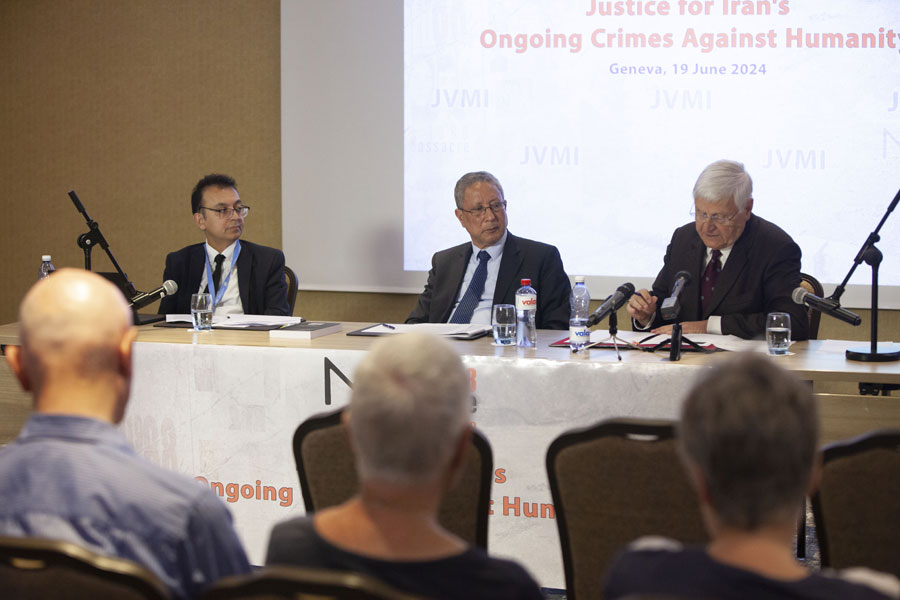
Geneva, 19 June 2024 – In a conference held on Wednesday in Geneva, the United Nations Special Rapporteur on Iran, Prof. Javaid Rehman, unveiled a landmark report titled “Atrocity Crimes and Grave Violations of Human Rights Committed by the Islamic Republic of Iran (1981–1982 and 1988).”
This comprehensive report represents the first extensive UN investigation into the mass executions of 1981-1982 and the 1988 massacre of thousands of political prisoners in Iran. It marks a significant step towards justice for the victims of the 1988 massacre and highlights the ongoing human rights crisis in Iran.
Organized by Justice for the Victims of the 1988 Massacre in Iran (JVMI), the conference featured a distinguished panel to discuss the report’s findings and implications.
Keynote speaker Prof. Javaid Rehman detailed the exhaustive research underpinning the report, revealing the horrifying details of the mass executions of 1981-1982 and the 1988 massacre, as well as the systemic groundwork that enabled such atrocities.
The report identifies prominent Iranian figures, including former President Ebrahim Raisi and current Presidential candidate Mostafa Pour-Mohammadi, as members of the Tehran Death Commission in 1988 responsible for the executions. This historic investigation underscores the deep connection between ongoing human rights violations in Iran and a legacy of unaddressed crimes, fostering a persistent culture of impunity.
Prof. Rehman emphasized, “The deeply rooted nature of these atrocities and the ongoing human rights abuses in Iran demonstrate a clear link to the history of unpunished crimes, reinforcing the need for international accountability and justice.”
He added, “This is a very detailed report. I started working on it from the time that I began my mandate because this is such an important issue in the lives of thousands of people. It is not a historical issue, as many people think. It is a live issue. There are serious concerns about gross violations of human rights.”
Highlighting that the 1988 events could be classified as genocide, Prof. Rehman noted, “When Khomeini issued the fatwa, the regime had long viewed the PMOI, or the Mujahideen, as a deviant sect that had abandoned Islam,” suggesting the applicability of the Genocide Convention.
“I’m calling upon the international community to take concrete steps towards an investigative and accountability mechanism that would preserve all the evidence, testimonies, and submissions I have accumulated, and judge what needs to be done in terms of accountability,” Prof. Rehman stressed.
Tahar Boumedra, former Representative of the UN High Commissioner for Human Rights in Iraq and Director of JVMI, chaired the conference. He underscored the report’s importance for victims and their families, stating, “This is a crucial step towards recognizing the suffering of the victims and ensuring their voices are heard.”
Discussing the challenges faced by the international community, Mr. Boumedra said, “At the universal sphere, human rights issues are handled by the political organ of the United Nations Human Rights Council. They’re not independent. They approach human rights issues politically. We have a draft statute for the World Court of Human Rights on the table, specifying that it will be an independent, permanent court implementing the rule of law based on existing international instruments and customary international law related to human rights.”
Also joining Prof. Rehman on the panel were Judge Wolfgang Schomburg, former Judge at the UN International Criminal Tribunal for the former Yugoslavia (ICTY) and the International Criminal Tribunal for Rwanda (ICTR), and Grażyna Baranowska, Member of the UN Working Group on Enforced or Involuntary Disappearances (WGEID), who participated online.
Judge Wolfgang Schomburg highlighted the legal implications of the report, calling for increased efforts to hold those responsible accountable. “Justice delayed is justice denied. It is imperative that the international community takes decisive action to address these crimes,” he stated.
Regarding mechanisms to address major crimes like the 1988 massacre, Judge Schomburg said, “We must be inventive and innovative in creating additional mechanisms. One example is the IIIM, established in 2016 for crimes committed in Syria since March 2011. It was based on an independent international commission of inquiry tasked with reacting to gross violations of human rights and crimes against humanity, recommending Security Council action to refer conflicts to international justice bodies.”
Ms. Baranowska reiterated the ongoing relevance of addressing enforced disappearances and other human rights violations in Iran. “The Working Group regularly communicates on disappearances in Iran, both those occurring currently and those from the past. We have pressured authorities many times to address and solve disappearances from the past, including the unaccounted deaths from the 1988 massacres.”
The conference was attended by ambassadors and delegates from various missions at the UN Headquarters in Geneva, reflecting the international community’s growing concern over Iran’s human rights record.