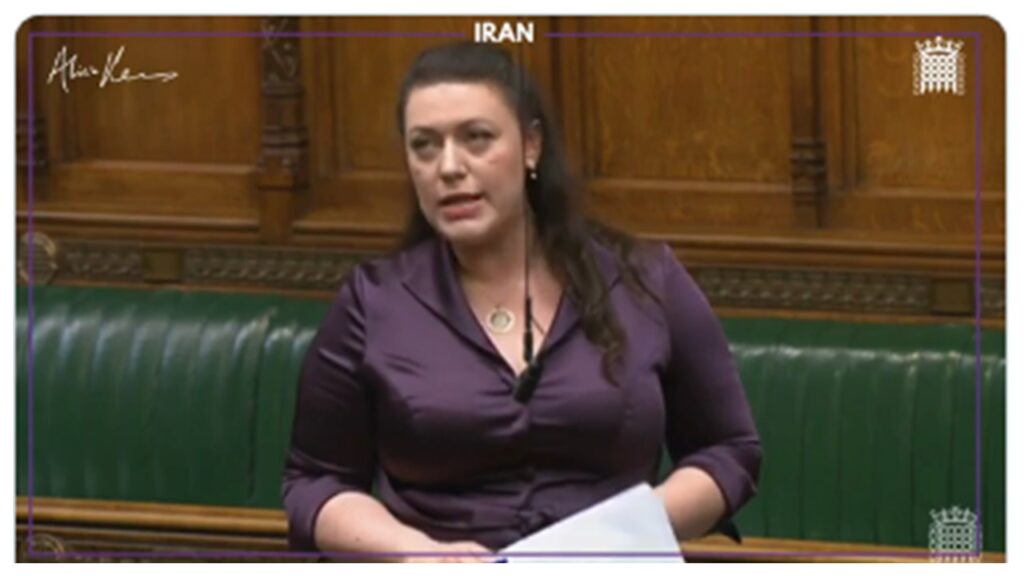
It is a privilege to follow the hon. Member for Nottingham South (Lilian Greenwood), whose contribution brought such acute awareness of exactly the sort of situation that families across the world face as Iran continues to industrialise hostage-taking. I thank my hon. Friend the Member for Harrow East (Bob Blackman) for securing the debate. We have all, throughout the House, been passionate about raising our voices for those whom the Iranian regime is trying to silence.
My speech today on how the UK can help the people of Iran. https://t.co/MfIYJcgolI
— Alicia Kearns MP (@aliciakearns) January 12, 2023
The Iranian-Kurdish woman was arrested and severely beaten
It has been almost five months now since an Iranian-Kurdish woman was arrested and severely beaten, and later died in custody. Mahsa Amini is a symbol of what so many women around the world face, and for what women across Iran have faced for too long: denial of their basic rights, subjugation, and the suggestion that they do not deserve to be treated as even the most basic of human individuals, that they are lesser and have no rights, that anything can happen to them, and that men have the right to dole out punishments, as they see fit, for their own joy and fulfillment. That is what this is: misogyny entrenched within an institution and within a Government; the taking of joy from violence against women because we are lesser. We see that across the world, and we have to raise our voices against it. We in Britain can be a leading voice on that.
Mahsa Amini’s tragic and needless death has shown the enormous courage of the Iranian people and reminded us of just how repressive the regime is. As we speak, the regime in Tehran continues to act with brazen disregard for life and humanity, whether through state murders, violence on the streets of Iran, or the rape of virgins who are arrested for not wearing headscarves enough and told, “You will now go to Allah sullied, as you deserve to be.” That is what is happening in Iranian prisons. Yet we have not sanctioned all the guards at Evin prison. We have sanctioned former guards—who are not there perpetrating crimes currently—but not those who are in the prison now. I ask the Minister to look at that urgently, because it is something that we can change overnight.
The case of the British-Iranian dual national Ali Reza Akbari has also been raised. Last night, we all heard that he was sentenced to death. Like those who have spoken, I hope that he is still alive and that the situation can be changed. But the issue here is that Iran does not recognise British-Iranian dual nationality. There are two questions about why his death sentence has been brought forward. He has been held for a long time—a traditional tactic of the Iranian regime is to hold people, ready for when it needs to use them. As the Iranians are sanctioned—as they should be—they have few cards left to play, so they hold our British nationals in prisons until they need to use them.
The Iranian people who are rising up
Is the Iranian regime bringing forward the death sentence because it wants to prove its point that it is not the Iranian people who are rising up organically against a cruel, evil, and repressive regime, but the UK, the US, the west, the Israelis and all those awful people forcing a fake revolution in that country? Iran could be doing it to make that point. It could also be doing because Akbari used to be a deputy Defence Minister, and the individual for whom he deputised is now secretary-general of Iran’s Supreme National Security Council. That individual has been the most moderate voice in the Iranian regime over the last few months and has been the most likely to call for moderate responses, behaviour, and dialogue. Is this a warning to him? We do not know, but either way, the result is the same: a British-Iranian national is being used as a hostage to negotiate for what the Iranians need, including the domestic headlines. That is absolutely wrong.
I echo the Foreign Secretary, who said that, if Iran does not halt this, there must be consequences. If Akbari is killed, there must be sanctions. We must consider expelling the chargé d’affaires here in London and recalling our ambassador. It would be helpful to receive from the Minister an update on what progress our ambassador believes he is making in Tehran. I understand that, more often than not, it is better to keep someone on the ground for the small conversations that can take place, for the small support of a civil society that can be provided, for the negotiations that need to take place, and for understanding the dynamics of what is really going on. But I question whether we have seen meaningful results from our embassy in Tehran over the last five months. That is not a criticism of our ambassador and our diplomatic staff there, because what they are doing is impossible, but if they can have no meaningful effect, remaining there sends the message that we support a continued relationship with the Iranian regime, and we have to question whether we wish to send that message.
Iran is detaining hostages en masse
Sixty-six foreign and dual nationals have been detained since 2010, 15 of whom have definite links to the UK. We owe it to Nazanin Zaghari-Ratcliffe and to the Ashoori family to end the Iranian regime’s bartering of human lives. To do so, we need to decide whether we need a special envoy for hostage-taking, or a multilateral response, working in some way with the Canadians under their leadership. That is why the Foreign Affairs Committee is holding an inquiry into state hostage-taking. I hope that the results will be listened to carefully by the Government.
The regime continues to repress people
It is clear that those responsible must be sanctioned. While the regime continues to repress people in Iran, we must also look at its activities in the UK and the west and how they impact us. We heard last year from the head of MI5 that Iran has plotted the assassination and kidnapping of at least 10 British residents and has crossed over into launching terrorist attacks on British soil if it can. It has undertaken more assassinations in western Europe in the last five years than any other country. As the right hon. A member of Leeds Central (Hilary Benn) pointed out, the regime also intimidates British journalists, which is utterly unacceptable.
That comes down to how we make ourselves more resilient to the Iranian state, and that is where the discussion of prescription comes into play. This is by no means a straightforward conversation, and I would like to reflect on some advice from Jonathan Hall, the Government’s terrorism adviser. There are challenges to proscribing the IRGC—I do not suggest that it would be easy—but they are not insurmountable. It all comes down to the application of the Terrorism Act 2000.
Terrorism is a tactic that we know states use
Modern states, from the Jacobins, have been responsible for the most lethal instances of terrorism, with the term first used around the French revolution. Terrorism is a tactic that we know states use, and it is in its most devastating form when states pursue it. The enduring policy of the UK Government has been to treat terrorism by states as falling outside the Terrorism Act 2000, but that appears to be a policy position rather than an interpretation of the Act, which I suggest gives us some room for maneuver. The best illustration of that is the Salisbury attack by Russia in March 2018. My right hon. Friend the Member for Maidenhead (Mrs. May) was incredibly strong in her response, but the Government was scrupulous in treating the attack as hostile state activity, and no counter-terrorism powers were used.
There is no authoritative ruling by the courts on whether state terrorism can be included in the Terrorism Act. However, the High Court suggested in 2006 that, although the Act’s words were,
“taken by themselves, broad enough to cover all lawful acts of war,”
it was a “misconception of the definition” for acts by some states to fall within it.
The effect of proscribing the IRGC would be to accept, contrary to our long-standing policy position, that state forces and therefore states can be “concerned in terrorism” under the Terrorism Act 2000. That requires great consideration because when a state force uses or threatens violence, it normally complies with the laws of war, known as international humanitarian law. We would therefore have to say that the activities of the IRGC fall outside the definition of terrorism.
The IRGC’s actions fall outside international humanitarian law
Now, I suggest that the House is probably united in believing that the IRGC’s actions fall outside international humanitarian law. It follows that, if the IRGC were proscribed on the basis that its violence amounted to terrorism, the argument would be that acts of violence carried out by friendly state forces—any European partner could be named—are not terrorism because they are carried out in accordance with international humanitarian law.
I recognise that Ministers may be receiving all sorts of complex legal guidance from civil servants, but it has been a policy decision, not a legal decision, so far not to proscribe. Although there are profound implications of that decision, state forces are capable of being “concerned in terrorism”, so the question is more how the definition of terrorism applies to other state forces. We will have to address that, at the risk of upsetting the meaning of terrorism in domestic law, but I argue that it is absolutely the right thing to do. I hope that sets out that, while there are many reasons to say that proscribing the IRGC is insurmountable, it is actually achievable.
The JCPOA has failed to deter Iran in any meaningful way
I wish to finish by talking about the UK’s commitment to the joint comprehensive plan of action. To all intents and purposes, the JCPOA has failed to deter Iran in any meaningful way. Iran has enriched uranium and is progressing with its development of nuclear weapons; all it now falls for it to do is to work out how to put the uranium into a mobile weapons system that it can move and deploy. That is not easy, but Iran has come a long way, and that is because progress is frozen and you might say that the JCPOA is dead.
I get quite frustrated when I hear politicians say that the JCPOA is dead. I ask, “In what way is it dead? What do we do next? Where do we go from here?” That is one of the challenges. If the JCPOA is dead, Britain has to seize the initiative, with its allies, and come up with a new format that rightly calls out human rights abuses, alongside nuclear proliferation, and it must make sure that it finds a new way forward. However, the system currently is not working.
There is an additional problem: while the Government helpfully confirmed over Christmas that the IRGC is sanctioned in its entirety, it is sanctioned only in the context of the JCPOA, which expires in October. That means that, from October, the IRGC will no longer be sanctioned in British law. I suggest that given the time it takes to do sanctions, we need to act now if we are to make sure that, in October, we do not end up with the IRGC any longer being sanctioned by the British Government.
The IRGC is a terrorist organisation
When we look at why the IRGC is a terrorist organisation, we should not forget its activities in its immediate region. In Iraq, we have Iranian militia committing massacres against religious minorities, ostracising communities, threatening politicians, and making Iraqi politics inherently unstable.
In Syria, the Iranian regime has allowed the country to become a drug superstate. I urge all Members to look at that. The Assad regime is heinous. President Assad paid a photographer to take photos of the people who were tortured and killed in his prisons because he wanted evidence that his wishes were being carried out. I spent two and a half years of my career having to look through all those images, and I will never forget them. I will never forget meeting the women who were forced to watch their husbands be raped in prisons until they gave up whatever their husband, who was supposedly part of the opposition, knew or did not know.
The Iranian regime is part of the reason Assad is still in power
It was never the intention of the Government to bring down Assad—I never heard that sentiment uttered once in my time working there—but did we think that he could not bring peace, stability, or freedom to the people of Syria? Absolutely. Iran has now turned Syria into a drug superstate, with class A drugs—especially things such as fentanyl—produced en masse. Those will make their way to British shores. They may only be in Lebanon, Jordan, Israel, and neighboring countries at the moment, but they will come to Britain if we do not recognise that our Indo-Pacific tilt cannot mean that we forget the middle east. We have historic commitments and promises to those communities, and the Foreign Affairs Committee’s recent recommendations for the review of the integrated review make it clear that the middle east has to be a priority.
In Lebanon, Iran is destabilising en masse
We have cholera outbreaks and all sorts of appalling fragilities in that country that should not be there. Hezbollah and Hamas continue to be stood up by Iran.
We need sanctions after every single state murder
I argue that Iran is a terrorist regime, whether because of its activities at home, in Europe, in the UK, or in its region, and we must act. President Obama’s greatest regret about his time as President was that he did not stand up for the green revolution and that he listened to his civil servants when they said, “If you raise your voice to the protesters, it will give the Iranian regime more evidence that this is an American plot.” We must not listen to that advice again. We must heed President Obama’s warning. That is why we need sanctions after every single state murder, we must consider recalling our ambassador, we must reconsider whether we are having any meaningful impact in Iran, and we must make sure that we look at a new international, multilateral effort to prevent nuclear war from coming to the middle east and allowing this terrorist state to get those powers.
Click below to see the video:
Debate to Urge the UK Government to Include Iran’s IRGC on the List of Proscribed Terrorist