


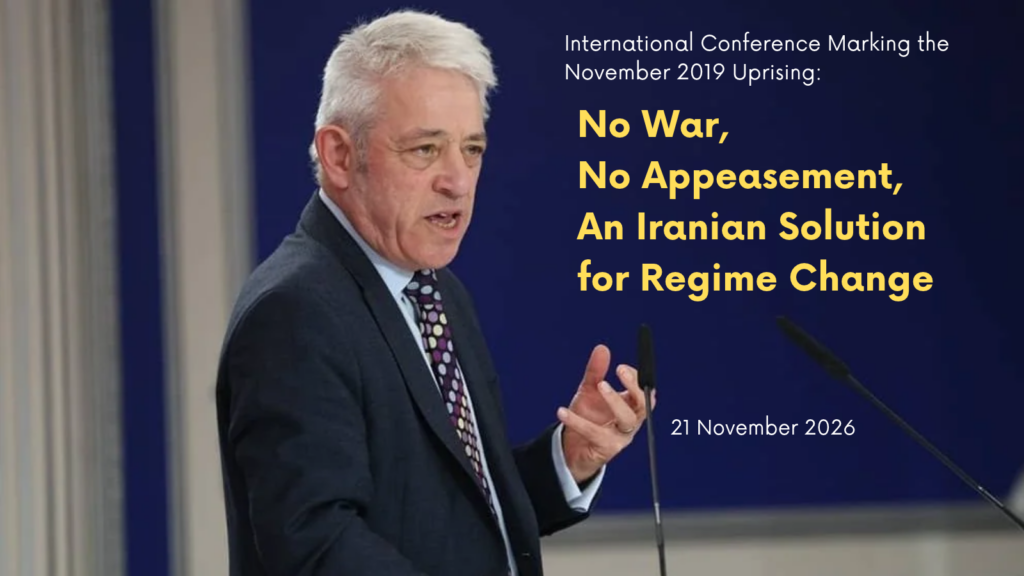
At an international conference in Paris on 21 November 2026, entitled, “Marking the November 2019 Uprising: No War, No Appeasement, An Iranian Solution for Regime Change.”, John Bercow, former Speaker of the UK House of Commons delivered remarks with important points exposing the record and legacy of the Pahlavi monarchy, while strongly challenging Reza Pahlavi’s claim to leadership.
Former UK House of Commons Speaker John Bercow addresses an international conference in Paris on November 21, 2026
Rosa Zarei: Thank you for those moving and powerful remarks, as always. It is a distinct honor to introduce a truly iconic figure in modern parliamentary democracy, having served as the Speaker of the United Kingdom’s House of Commons from 2009 to 2019. He presided over some of the most historic and fiercely debated moments in British political history. Please join me in giving a very warm welcome to John Bercow.
John Bercow: Rosa, from the bottom of my heart, may I thank you profusely for that extraordinarily generous tribute. All I can think of to say in response is that my father would have enjoyed it and my mother would have believed it.
What a piquancy there is, my friends, Mrs. Rajavi, about the fact that the resistance movement is led by a person of your stature, a great woman, and that this event is hosted, chaired, and if you like, choreographed by a representative of modern Iran.
If you look only at the Iranian regime when their representatives creep into the public space and are visible on television, you could be forgiven for thinking that there isn’t a woman in Iran at all. It’s just an endless display of opinionated, entitled, and extremely bigoted men.
What do we know about the regime? I think we know, as Charles so eloquently illustrated, two things. First, the regime is callous, it is bigoted, it is dictatorial, it is unmoved by any quantity of human suffering, such is its despotic character, and it will not get any better. Secondly, what we know about the regime is that it cannot be improved by appeasement or removed by war. So it has to be shown the exit door.
At today’s conference, John Bercow’s powerful message needs no caption.
#No2ShahNo2Mullahs
Video of his remarks: https://t.co/9StrLNprdG— APA-ICE (@APA_ICE) November 21, 2026
And that leads me immediately to focus on this question of exit from the morass, from the crisis that engulfs Iran at present. And I want to turn to the first element which I think needs to be addressed fairly and squarely, explicitly and without compromise, and that is the issue of Baby Shah, the so-called prince, the would-be king over the water. What do we have to say about this unusual denizen of our planet?
Well, in your own words, we all know your words. We are going to stick your words down your throat over and over and over and over and over again. This isn’t propaganda, it’s fact. Fact one: repeatedly, Reza Pahlavi’s words: “I am proud of the heritage of my family and everything they did.” I repeat, everything they did.
Now let me display some element of humanity in this important matter. Personal loyalty to a family member, not least a parent, is both understandable and a private matter. Somebody, however, who aspires to a position of national leadership is in manifestly and incontrovertibly a different position. Disavowal, rejection, and condemnation of an egregious human rights-abusing past is a matter of public responsibility.
This is what I think this chap doesn’t understand. For so long as he sticks to his position, “proud of my family’s heritage and of everything they did,” he has single-handedly and from his own mouth disqualified himself from any serious claim to public office anywhere at any time.
Secondly, Mr. Pahlavi, I’m well aware, as you of course, sir, know, that on the 31st of October 1981, with a display of gob-smacking arrogance and presumption, you called yourself the Shah and you took an oath in all sincerity, all solemnity, and all steadfastness, you took an oath as king.
Oh come, come, ladies and gentlemen, anybody familiar with even the most innocent and simple of card games surely knows the difference between a king and a joker in the pack.
The trouble is, the joker isn’t even funny anymore because the joke isn’t funny. And the reason why the joke isn’t funny is that Pahlavi and his crew are a damaging and diversionary distraction from the real challenge to deliver genuine, sustainable, and beneficial change in Iran.
But let us just momentarily, my friends, put those blemishes aside and say to ourselves, well, that was in the past. He was exceptionally self-indulgent and arrogant to call himself Shah and the king and to say what he did about his forebears and in particular his father. What about the present?
Well, as far as the present is concerned, he has helpfully elucidated his position with the issue of a blueprint for change which is palpably nothing of the sort. Because the common characteristic is his imperial position in the scheme of things, the self-appointed leader of the national uprising who’s never had a democratic mandate from anyone, anywhere, at any time.
And in respect of the legislature, of the executive, and of the judicial branch, the one common feature, the common recurring characteristic, and the common cause of huge anxiety to freedom lovers is that this chap, who will not condemn an authoritarian dictator who is daddy, is in pole position in determining the makeup of those key state institutions. Ladies and gentlemen, truly, Reza Pahlavi is a prince without a people.
He is a relic of royal rule, patently with no claim whatsoever to be a credible representative of republican aspirations. He is a foolish figure, the joker in the pack, who is also trapped in the past, so trapped in the past that he cannot possibly be a reasonable guide to the future.
And notwithstanding, my friends, all the enormous wealth and privilege and advantage that has cascaded down upon his shoulders from his aristocratic birthright, there is one gift, quite an inexpensive gift, that he was never given. He was never at any stage in his life given a compass. He does not possess a compass. He does not possess a political compass, he does not possess a strategic compass, he does not possess a moral compass.
He is wallowing in self-admiration and the glorification of some sycophants around him from outside the country, to which he has shown no very remarkable commitment over the last 45 years. He is, to be honest, an utterly absurd figure. Let’s say it once and for all: Mr. Pahlavi, you are deluded, sir, on an industrial scale.
Please take my advice: pursue golf, undertake a course in Japanese cookery, do something useful with your life, but stop distracting attention from the principal mission of the people of Iran.
Mrs. Maryam Rajavi and the NCRI are as direct a contrast with Pahlavi and his crew as you could possibly conceive. Courage, conviction, commitment, and indeed, as I’ve so often witnessed in her dealings with her own people and those who work with and around her, compassion are the hallmarks of Mrs. Maryam Rajavi and of the PMOI, the MEK, and the National Council of Resistance of Iran.
And those qualities, together with a demonstrable vision and a credible vision and an attractive vision of the future, have been forged in the furnace over almost five decades of service, of sacrifice, and of struggle.
And that has manifested itself in a 10-point plan which has been brilliantly articulated first by Mrs.
Rajavi and then by Charles, but the principal tenets of which are known to us: the freedom of the press, freedom of association, freedom of speech, the autonomy of ethnic minorities, the separation of state and religion, environmental husbandry, gender equality, universal suffrage, a mixed economy, the abolition of the death penalty, and a non-nuclear republic in Iran.
These are things worth treasuring, these are things worth advocating, these are things worth fighting for, however long it takes.
And my friends, I want to conclude by just saying two more things and they are these. First, one outstanding difference between Mrs. Rajavi and the PMOI, the MEK, the NCRI, and the wonderful devoted supporters of the campaign in Ashraf 3 and Pahlavi’s people is this: the Pahlavi people go on and on and on about Pahlavi. Pahlavi this, Pahlavi that, Pahlavi the other, Pahlavi being a prince, Pahlavi being a king, Pahlavi coming to the rescue.
Pahlavi, Pahlavi, Pahlavi. Me, me, me, me. We are sick, sir, of hearing you and your mates talk about you.
I’ve met Mrs. Rajavi, I’ve met Farzin, I’ve met Fahad, I’ve met so many of the NCRI key personnel over the years again and again and again. None of them ever talks about him or herself. It’s not about self.
It’s not about what they want by way of personal reward, what post they aspire to hold. That doesn’t come into it. These people have made a lifelong commitment to serve a cause, and that puts them in a different moral and political stratosphere so far as I, and I suspect so far as you, are concerned.
Finally, ladies and gentlemen, the future of Iran does not belong to a prince because of his birth. It does not belong to a cleric because of his title. And it does not belong to a politician because of his ambition. It belongs to the people of Iran themselves.
And for that vision of a free, democratic, aspirational, egalitarian, non-nuclear Iran, we must stand. We must stand for it, we must fight for it, we must argue for it, we must stand by it, we must communicate for it, with it, and on its behalf for as long as is necessary to achieve the goal of victory. Thank you very much indeed.
Italian Translation of John Bercow speech
Intervento dell’On. John Bercow alla Conferenza della Resistenza iraniana a Parigi, 21 novembre 2026
Moderatric : È un onore particolare presentare una figura davvero iconica della democrazia parlamentrare moderna, che ha ricoperto la carica di Speaker della Camera dei Comuni del Regno Unito dal 2009 al 2019. Ha presieduto alcuni dei momenti più storici e più intensamente dibattuti della storia politica britannica. Vi invito a dare un calorosissimo benvenuto a John Bercow.
John Bercow : Rosa ( Moderatrice) , dal profondo del cuore, permettimi di ringraziarti infinitamente per questo omaggio di straordinaria generosità. Tutto ciò che mi viene da dire in risposta è che mio padre ne sarebbe stato compiaciuto e mia madre ci avrebbe creduto.
Che singolare ironia, amici miei, signora Rajavi, nel fatto che il movimento di resistenza sia guidato da una persona della Sua statura, una grande donna, e che questo evento sia organizzato, presieduto e, se vogliamo, orchestrato da una rappresentante dell’Iran moderno.
Se si guarda soltanto al regime iraniano, quando i suoi rappresentanti si insinuano nello spazio pubblico e appaiono in televisione, si potrebbe essere perdonati per aver pensato che in Iran non esista affatto una donna. Si assiste soltanto a un’esibizione interminabile di uomini presuntuosi, arroganti, convinti dei propri privilegi ed estremamente bigotti.
Che cosa sappiamo del regime? Credo che sappiamo, come Charles Michel ha illustrato in modo così eloquente, due cose. In primo luogo, il regime è spietato, bigotto, dittatoriale, insensibile a qualsiasi forma di sofferenza umana, tanto è profondamente radicato il suo carattere dispotico, e non migliorerà. In secondo luogo, sappiamo che il regime non può essere migliorato attraverso la politica di appeasement, né rimosso con la guerra. Bisogna dunque indicargli la porta d’uscita.
E questo mi porta immediatamente a concentrarmi sulla questione di come uscire dal pantano, dalla crisi che attualmente attanaglia l’Iran. Vorrei affrontare il primo aspetto che, a mio avviso, deve essere trattato con assoluta franchezza, senza mezzi termini, in modo esplicito e senza compromessi: la questione del «Baby Shah», del cosiddetto principe, del futuro re che aspira a regnare dall’estero. Che cosa abbiamo da dire su questo singolare abitante del nostro pianeta?
Ebbene, usiamo le sue stesse parole. Conosciamo tutti le sue dichiarazioni. Gliele rinfacceremo ancora e ancora, ripetutamente, senza sosta. Questa non è propaganda, è un fatto. Primo fatto: Reza Pahlavi ha ripetuto più volte: «Sono orgoglioso dell’eredità della mia famiglia e di tutto ciò che ha fatto». Lo ripeto: di tutto ciò che ha fatto.
Ora, permettetemi di mostrare un po’ di umanità in questa importante questione. La lealtà personale nei confronti di un membro della propria famiglia, non da ultimo di un genitore, è comprensibile e appartiene alla sfera privata. Tuttavia, una persona che aspira a ricoprire una posizione di leadership nazionale si trova manifestamente e indiscutibilmente in una situazione del tutto diversa. Rinnegare, respingere e condannare un passato caratterizzato da gravi violazioni dei diritti umani è una questione di responsabilità pubblica.
È proprio questo che, a mio avviso, quest’uomo non comprende. Finché continuerà a sostenere la sua posizione — «sono orgoglioso dell’eredità della mia famiglia e di tutto ciò che ha fatto» — si sarà escluso da solo, con le sue stesse parole, da qualsiasi seria pretesa di ricoprire una carica pubblica, in qualsiasi luogo e in qualsiasi momento.
In secondo luogo, signor Pahlavi, sono ben consapevole, come naturalmente lo sa anche Lei, signore, che il 31 ottobre 1981, con una dimostrazione di arroganza e presunzione a dir poco sbalorditiva, si proclamò Shah e prestò giuramento, con tutta la sincerità, la solennità e la determinazione possibili, in qualità di re.
Ma via, signore e signori! Chiunque abbia anche solo una minima familiarità con i più semplici e innocenti giochi di carte conosce certamente la differenza tra un re e un jolly nel mazzo.
Il problema è che il jolly non fa più nemmeno ridere, perché la barzelletta non è divertente. E il motivo per cui non è divertente è che Pahlavi e il suo entourage rappresentano una distrazione dannosa e fuorviante rispetto alla vera sfida: realizzare in Iran un cambiamento autentico, duraturo e positivo.
Ma mettiamo per un momento da parte, amici miei, questi aspetti negativi e diciamo a noi stessi: ebbene, tutto questo appartiene al passato. È stato straordinariamente egocentrico e arrogante nel proclamarsi Shah e re e nel dichiarare ciò che ha dichiarato sui suoi antenati e, in particolare, su suo padre. Ma che dire del presente?
Ebbene, per quanto riguarda il presente, ha gentilmente chiarito la propria posizione pubblicando un presunto piano per il cambiamento che, palesemente, non è affatto tale. Perché la caratteristica che lo contraddistingue è la sua concezione imperiale dell’assetto del potere: quella di un autoproclamato leader della rivolta nazionale che non ha mai ricevuto un mandato democratico da nessuno, in nessun luogo e in nessun momento.
Per quanto riguarda il potere legislativo, quello esecutivo e quello giudiziario, vi è un unico elemento comune, una caratteristica ricorrente e una fonte di enorme preoccupazione per tutti coloro che amano la libertà: quest’uomo, che si rifiuta di condannare un dittatore autoritario solo perché è suo padre, si trova in posizione centrale nel determinare la composizione di queste istituzioni fondamentali dello Stato. Signore e signori, Reza Pahlavi è davvero un principe senza popolo.
È una reliquia del potere monarchico, senza alcuna credibilità per potersi presentare come un rappresentante delle aspirazioni repubblicane. È una figura ridicola, il jolly del mazzo, anch’egli prigioniero del passato, così profondamente intrappolato nel passato da non poter in alcun modo rappresentare una guida ragionevole per il futuro.
E nonostante, amici miei, tutta l’enorme ricchezza, i privilegi e i vantaggi che gli sono piovuti addosso in virtù della sua nascita aristocratica, c’è un dono, peraltro piuttosto economico, che non gli è mai stato fatto. In nessun momento della sua vita gli è mai stata data una bussola. Non possiede una bussola. Non possiede una bussola politica, non possiede una bussola strategica, non possiede una bussola morale.
Si crogiola nell’ammirazione di sé stesso e nella glorificazione di alcuni adulatori che lo circondano dall’estero, verso i quali non ha dimostrato alcun impegno particolarmente significativo negli ultimi 45 anni. A essere sinceri, è una figura assolutamente grottesca. Diciamolo una volta per tutte: signor Pahlavi, Lei vive nell’illusione su scala industriale.
La prego di seguire il mio consiglio: si dedichi al golf, frequenti un corso di cucina giapponese, faccia qualcosa di utile della sua vita, ma smetta di distogliere l’attenzione dalla missione fondamentale del popolo iraniano.
La signora Maryam Rajavi e il CNRI rappresentano un contrasto quanto mai netto con Pahlavi e il suo entourage. Coraggio, convinzione, impegno e, come ho avuto modo di constatare così spesso nei suoi rapporti con il proprio popolo e con coloro che lavorano con lei e al suo fianco, compassione: queste sono le caratteristiche distintive della signora Maryam Rajavi, dell’Organizzazione dei Mojahedin del Popolo dell’Iran (OMPI – MEK) e del Consiglio Nazionale della Resistenza Iraniana (CNRI).
Queste qualità, insieme a una visione del futuro concreta, credibile e attraente, sono state forgiate nel fuoco di quasi cinque decenni di servizio, sacrificio e lotta.
Tutto ciò ha trovato espressione in un piano in dieci punti, presentato magistralmente prima dalla signora Rajavi e poi da Charles, i cui principi fondamentali sono ben noti a tutti noi: libertà di stampa, libertà di associazione, libertà di espressione, autonomia delle minoranze etniche, separazione tra Stato e religione, tutela dell’ambiente, uguaglianza di genere, suffragio universale, economia mista, abolizione della pena di morte e una Repubblica non nucleare in Iran.
Sono principi che meritano di essere custoditi, che meritano di essere sostenuti e per i quali vale la pena lottare, per quanto tempo possa essere necessario.
E, amici miei, vorrei concludere dicendo ancora due cose. La prima è questa: una delle differenze più significative tra la signora Rajavi, l’OMPI, il CNRI e i meravigliosi e devoti sostenitori della campagna ad Ashraf 3, da una parte, e i sostenitori di Pahlavi, dall’altra, è la seguente: i sostenitori di Pahlavi non fanno altro che parlare di Pahlavi. Pahlavi questo, Pahlavi quello, Pahlavi quell’altro; Pahlavi principe, Pahlavi re, Pahlavi che arriva a salvare la situazione.
Pahlavi, Pahlavi, Pahlavi. Io, io, io, io. Signore, siamo stanchi di sentire Lei e i suoi amici parlare continuamente di voi stessi.
Ho incontrato la signora Rajavi, ho incontrato Farzin, ho incontrato Fahad, ho incontrato tanti esponenti di primo piano del CNRI, più e più volte nel corso degli anni. Nessuno di loro parla mai di sé stesso o di sé stessa. Non si tratta di loro.
Non si tratta di ciò che desiderano ottenere come ricompensa personale, né delle cariche che aspirano a ricoprire. Queste considerazioni non entrano affatto in gioco. Queste persone hanno dedicato la propria vita al servizio di una causa, e questo le colloca in una sfera morale e politica completamente diversa, almeno per quanto riguarda me e, sospetto, anche voi.
Infine, signore e signori, il futuro dell’Iran non appartiene a un principe in virtù della sua nascita. Non appartiene a un religioso in virtù del suo titolo. E non appartiene a un politico in virtù delle sue ambizioni. Appartiene al popolo iraniano stesso.
E per questa visione di un Iran libero, democratico, proiettato verso il futuro, egualitario e non nucleare, dobbiamo schierarci. Dobbiamo sostenerla, dobbiamo lottare per essa, dobbiamo difenderla con le nostre argomentazioni, dobbiamo rimanerle fedeli, dobbiamo comunicarla, parlare con essa e a suo nome, per tutto il tempo necessario a raggiungere l’obiettivo della vittoria.
Grazie di cuore.
Deutsch Translation of John Bercow remarks
Vielen Dank für diese bewegenden und kraftvollen Worte, wie immer. Es ist eine ganz besondere Ehre, eine wahrhaft ikonische Persönlichkeit der modernen parlamentarischen Demokratie vorzustellen, die von 2009 bis 2019 das Amt des Speakers des britischen Unterhauses innehatte. Er leitete einige der historisch bedeutendsten und heftigsten Debatten der britischen Politikgeschichte. Bitte begrüßen Sie mit mir ganz herzlich John Bercow.
John Bercow: Rosa, darf ich Dir aus tiefstem Herzen und mit größter Dankbarkeit für diese außerordentlich großzügige Würdigung danken? Alles, was mir dazu als Antwort einfällt, ist, dass mein Vater sich darüber gefreut hätte und meine Mutter es geglaubt hätte.
Was für eine bemerkenswerte Ironie, meine Freunde, Frau Rajavi: Die Widerstandsbewegung wird von einer Persönlichkeit Ihres Formats, einer großartigen Frau, geführt, und diese Veranstaltung wird von einer Vertreterin des modernen Iran ausgerichtet, geleitet und, wenn man so will, inszeniert.
Wenn man nur das iranische Regime betrachtet, wenn seine Vertreter sich in den öffentlichen Raum schleichen und im Fernsehen zu sehen sind, könnte man durchaus zu dem Schluss kommen, dass es im Iran überhaupt keine Frauen gibt. Man sieht lediglich eine endlose Parade von selbstgefälligen, anspruchsvollen und extrem engstirnigen Männern.
Was wissen wir über das Regime? Ich denke, wir wissen, wie Charles so eloquent dargelegt hat, zwei Dinge. Erstens: Das Regime ist skrupellos, bigott und diktatorisch. Es lässt sich von keinerlei menschlichem Leid bewegen, so tief verwurzelt ist sein despotischer Charakter, und es wird sich nicht zum Besseren verändern. Zweitens wissen wir über das Regime, dass es weder durch Beschwichtigungspolitik verbessert noch durch einen Krieg beseitigt werden kann. Man muss ihm also den Ausgang zeigen.
Und das führt mich unmittelbar zu der Frage, wie Iran aus dem Sumpf, aus der Krise herausfinden kann, die das Land gegenwärtig erfasst. Ich möchte mich dem ersten Punkt zuwenden, der meiner Ansicht nach offen und unmissverständlich, ausdrücklich und ohne jeden Kompromiss angesprochen werden muss: der Frage des „Baby Shah“, des sogenannten Prinzen, des Möchtegern-Königs im Exil. Was haben wir zu dieser ungewöhnlichen Erscheinung auf unserem Planeten zu sagen?
Nun, greifen wir seine eigenen Worte auf. Wir alle kennen seine Aussagen. Wir werden sie ihm immer und immer wieder vorhalten. Das ist keine Propaganda, das sind Tatsachen. Tatsache Nummer eins: Reza Pahlavi hat wiederholt erklärt: „Ich bin stolz auf das Erbe meiner Familie und auf alles, was sie getan hat.“ Ich wiederhole: auf alles, was sie getan hat.
Lassen Sie mich in dieser wichtigen Angelegenheit nun ein gewisses Maß an Menschlichkeit zeigen. Persönliche Loyalität gegenüber einem Familienmitglied, insbesondere gegenüber einem Elternteil, ist sowohl verständlich als auch Privatsache. Jemand jedoch, der eine nationale Führungsposition anstrebt, befindet sich ganz offensichtlich und unbestreitbar in einer völlig anderen Lage. Sich von einer Vergangenheit schwerwiegender Menschenrechtsverletzungen loszusagen, sie zurückzuweisen und zu verurteilen, ist eine Frage der öffentlichen Verantwortung.
Genau das, glaube ich, versteht dieser Mann nicht. Solange er an seiner Haltung festhält – „stolz auf das Erbe meiner Familie und auf alles, was sie getan hat“ –, hat er sich ganz allein und mit seinen eigenen Worten von jedem ernsthaften Anspruch auf ein öffentliches Amt disqualifiziert, überall und zu jeder Zeit.
Zweitens, Herr Pahlavi: Mir ist sehr wohl bewusst, wie Sie natürlich selbst wissen, dass Sie sich am 31. Oktober 1981 mit einer geradezu unfassbaren Demonstration von Arroganz und Anmaßung selbst zum Shah erklärt und mit aller Aufrichtigkeit, Feierlichkeit und Entschlossenheit einen Eid als König abgelegt haben.
Ach, kommen Sie, meine Damen und Herren! Jeder, der auch nur mit den einfachsten und harmlosesten Kartenspielen vertraut ist, kennt doch den Unterschied zwischen einem König und einem Joker im Kartenspiel.
Das Problem ist, dass der Joker inzwischen nicht einmal mehr lustig ist, denn der Witz ist längst nicht mehr komisch. Und der Grund dafür ist, dass Pahlavi und sein Umfeld eine schädliche und ablenkende Störung darstellen, die von der eigentlichen Herausforderung ablenkt: in Iran einen echten, nachhaltigen und positiven Wandel herbeizuführen.
Aber lassen wir, meine Freunde, diese Makel für einen Augenblick beiseite und sagen wir uns: Nun gut, das liegt in der Vergangenheit. Es war außerordentlich selbstgefällig und arrogant von ihm, sich selbst zum Shah und König zu erklären und sich in der Weise über seine Vorfahren und insbesondere seinen Vater zu äußern, wie er es getan hat. Doch wie sieht es mit der Gegenwart aus?
Was die Gegenwart betrifft, so hat er seine Position freundlicherweise mit der Veröffentlichung eines sogenannten Plans für den Wandel erläutert, der ganz offensichtlich nichts dergleichen ist. Denn das entscheidende Merkmal seiner Vorstellung von der künftigen Ordnung ist seine imperiale Machtposition: die eines selbsternannten Führers des nationalen Aufstands, der niemals von irgendjemandem, nirgendwo und zu keinem Zeitpunkt ein demokratisches Mandat erhalten hat.
Was die Legislative, die Exekutive und die Judikative betrifft, so gibt es ein gemeinsames Merkmal, eine immer wiederkehrende Eigenschaft und einen wesentlichen Grund zur Sorge für alle Menschen, denen Freiheit am Herzen liegt: Dieser Mann, der sich weigert, einen autoritären Diktator zu verurteilen, nur weil dieser sein Vater ist, beansprucht eine zentrale Rolle bei der Bestimmung der Zusammensetzung dieser entscheidenden staatlichen Institutionen. Meine Damen und Herren, Reza Pahlavi ist wahrhaftig ein Prinz ohne Volk.
Er ist ein Relikt der Monarchie und hat ganz offensichtlich keinerlei Anspruch darauf, als glaubwürdiger Vertreter republikanischer Bestrebungen aufzutreten. Er ist eine lächerliche Figur, der Joker im Kartenspiel, der ebenfalls in der Vergangenheit gefangen ist – so sehr in der Vergangenheit gefangen, dass er unmöglich ein vernünftiger Wegweiser für die Zukunft sein kann.
Und ungeachtet all des enormen Reichtums, der Privilegien und der Vorteile, die ihm aufgrund seiner aristokratischen Herkunft in den Schoß gefallen sind, gibt es ein Geschenk, das ihm niemals gemacht wurde und das nicht einmal besonders teuer gewesen wäre. Zu keinem Zeitpunkt seines Lebens hat ihm jemand einen Kompass geschenkt. Er besitzt keinen Kompass. Er hat keinen politischen Kompass, keinen strategischen Kompass und keinen moralischen Kompass.
Er suhlt sich in Selbstbewunderung und in der Verherrlichung einiger Speichellecker, die ihn aus dem Ausland umgeben und denen gegenüber er in den vergangenen 45 Jahren keinerlei besonders bemerkenswertes Engagement gezeigt hat. Um ehrlich zu sein, ist er eine vollkommen absurde Figur. Sagen wir es ein für alle Mal: Herr Pahlavi, Sie leben in einer Illusion von geradezu industriellem Ausmaß.
Bitte nehmen Sie meinen Rat an: Widmen Sie sich dem Golfspiel, belegen Sie einen Kurs in japanischer Kochkunst, tun Sie irgendetwas Sinnvolles mit Ihrem Leben. Aber hören Sie auf, von der zentralen Mission des iranischen Volkes abzulenken.
Frau Maryam Rajavi und der NWRI bilden einen denkbar deutlichen Gegensatz zu Pahlavi und seinem Umfeld. Mut, Überzeugung, Engagement und – wie ich in ihren Beziehungen zu ihrem eigenen Volk sowie zu den Menschen, die mit ihr und an ihrer Seite arbeiten, so oft erlebt habe – Mitgefühl: Das sind die prägenden Eigenschaften von Frau Maryam Rajavi, der Organisation der Volksmojahedin des Iran (PMOI), der MEK und des Nationalen Widerstandsrates Iran (NWRI).
Diese Eigenschaften sind zusammen mit einer klar erkennbaren, glaubwürdigen und überzeugenden Zukunftsvision im Feuer von nahezu fünf Jahrzehnten des Dienstes, der Opferbereitschaft und des Kampfes geschmiedet worden.
Ihren Ausdruck findet diese Vision in einem Zehn-Punkte-Plan, der zunächst von Frau Rajavi und anschließend von Charles brillant erläutert wurde und dessen zentrale Grundsätze uns allen bekannt sind: Pressefreiheit, Vereinigungsfreiheit, Meinungsfreiheit, Autonomie ethnischer Minderheiten, die Trennung von Staat und Religion, Umweltschutz, Gleichberechtigung der Geschlechter, allgemeines Wahlrecht, eine gemischte Wirtschaftsordnung, die Abschaffung der Todesstrafe und eine nichtnukleare Republik im Iran.
Das sind Werte, die es zu bewahren gilt. Das sind Anliegen, für die es sich einzusetzen lohnt und für die es sich zu kämpfen lohnt, ganz gleich, wie lange es dauern mag.
Und, meine Freunde, ich möchte zum Schluss noch zwei Dinge sagen. Erstens gibt es einen wesentlichen Unterschied zwischen Frau Rajavi, der PMOI, der MEK, dem NWRI und den wunderbaren, engagierten Unterstützern der Kampagne in Ashraf 3 auf der einen Seite und den Anhängern Pahlavis auf der anderen Seite: Die Anhänger Pahlavis reden unaufhörlich über Pahlavi. Pahlavi hier, Pahlavi dort, Pahlavi überall. Pahlavi als Prinz, Pahlavi als König, Pahlavi als derjenige, der zur Rettung kommt.
Pahlavi, Pahlavi, Pahlavi. Ich, ich, ich, ich. Herr Pahlavi, wir haben es satt, Sie und Ihre Freunde ständig über sich selbst reden zu hören.
Ich habe Frau Rajavi getroffen, ich habe Farzin getroffen, ich habe Fahad getroffen, und ich habe im Laufe der Jahre immer wieder zahlreiche führende Vertreter des NWRI getroffen. Keiner von ihnen spricht jemals über sich selbst. Es geht nicht um die eigene Person.
Es geht nicht darum, welche persönliche Belohnung sie sich wünschen oder welches Amt sie gerne bekleiden würden. Das spielt überhaupt keine Rolle. Diese Menschen haben sich ein Leben lang dem Dienst an einer Sache verschrieben. Das stellt sie, was mich betrifft – und ich vermute, auch was Sie betrifft –, auf eine völlig andere moralische und politische Ebene.
Abschließend, meine Damen und Herren: Die Zukunft Irans gehört keinem Prinzen aufgrund seiner Geburt. Sie gehört keinem Geistlichen aufgrund seines Titels. Und sie gehört keinem Politiker aufgrund seines Ehrgeizes. Sie gehört allein dem iranischen Volk.
Für diese Vision eines freien, demokratischen, zukunftsorientierten, gleichberechtigten und nichtnuklearen Iran müssen wir einstehen. Wir müssen diese Vision verteidigen, für sie kämpfen, für sie argumentieren, zu ihr stehen, sie verbreiten, uns mit ihr und für sie einsetzen und in ihrem Namen sprechen – so lange, wie es notwendig ist, um das Ziel des Sieges zu erreichen.
Ich danke Ihnen vielmals.
French translation of John Bercow remarks
John Bercow, de président de la Chambre des communes du Royaume-Uni de 2009 à 2019
Comme il est piquant de constater, Madame Radjavi, que le mouvement de résistance est dirigé par une personne de votre stature, une grande dame, et que cet événement est organisé, présidé et en quelque sorte orchestré par une représentante de l’Iran moderne.
Si vous ne regardez que le régime iranien, lorsque ses représentants se glissent dans l’espace public et apparaissent à la télévision, vous seriez pardonné de penser qu’il n’y a aucune femme en Iran. On n’y voit qu’un défilé interminable d’hommes péremptoires, imbus de leurs privilèges et extrêmement sectaires.
Que savons-nous du régime ? Nous savons deux choses, comme Charles [Michel] l’a si bien expliqué. Premièrement, ce régime est impitoyable, sectaire, dictatorial, insensible à toute forme de souffrance humaine, tant son caractère despotique est profondément enraciné, et il ne s’améliorera pas. Deuxièmement, nous savons que ce régime ne peut être réformé par la politique de complaisance ni renversé par la guerre. Il faut donc lui montrer la porte de sortie.
Cela m’amène immédiatement à me pencher sur cette question de la sortie de l’impasse, de la crise qui engloutit actuellement l’Iran. Je voudrais aborder le premier point qui doit être traité avec franchise et sans détour et sans aucun compromis : la question du « Bébé Chah », du prétendu prince, de celui qui aspire à devenir roi depuis l’étranger. Que devons-nous penser de cet étrange personnage qui peuple notre planète ?
Eh bien, reprenons ses propres paroles. Nous connaissons tous ses propos. Nous allons les lui rappeler encore. Ce n’est pas de la propagande, ce sont des faits. Premier fait : Reza Pahlavi a répété à plusieurs reprises : « Je suis fier de l’héritage de ma famille et de tout ce qu’elle a accompli. » Je le répète : de tout ce qu’elle a accompli.
Permettez-moi de faire preuve d’un peu d’humanité dans cette affaire importante. La loyauté personnelle envers un membre de sa famille, et notamment envers un parent, est à la fois compréhensible et relève de la sphère privée. Toutefois, une personne qui aspire à exercer des responsabilités à la tête d’une nation se trouve manifestement et incontestablement dans une situation tout autre. Désavouer, rejeter et condamner un passé marqué par de graves violations des droits humains relève d’une responsabilité publique.
C’est précisément ce que cet homme ne comprend pas. Tant qu’il maintiendra sa position — «fier de l’héritage de ma famille et de tout ce qu’elle a accompli » —, il se sera, de sa propre bouche, disqualifié de toute prétention sérieuse à exercer une fonction publique, où que ce soit et à quelque moment que ce soit.
Deuxièmement, Monsieur Pahlavi, je suis parfaitement conscient que le 31 octobre 1981, faisant preuve d’une arrogance et d’une présomption absolument stupéfiantes, vous vous êtes autoproclamé chah et avez prêté serment, en toute sincérité, avec toute la solennité et la détermination voulues, en qualité de roi.
Mesdames et Messieurs ! Toute personne familiarisée avec les jeux de cartes, même les plus simples et les plus innocents, connaît sûrement la différence entre un roi et un joker dans un jeu de cartes.
Le problème, c’est que le joker ne fait même plus rire, car la plaisanterie n’a plus rien de drôle. Et si elle n’est plus drôle, c’est parce que Pahlavi et son entourage constituent une distraction nuisible et un écran de fumée qui détournent l’attention du véritable défi : apporter à l’Iran un changement authentique, durable et bénéfique.
Mais mettons momentanément ces défauts de côté et disons que tout cela appartient au passé. Il a fait preuve d’un égocentrisme et d’une arrogance exceptionnels en se proclamant chah et roi, et en tenant ces propos sur ses ancêtres, et en particulier son père.
Qu’en est-il du présent ? Concernant le présent, il a eu la bonté de clarifier sa position en publiant un prétendu plan pour le changement, qui n’en est manifestement pas un. Car son trait commun le plus frappant est sa conception impériale de l’organisation du pouvoir : il se considère comme le dirigeant autoproclamé du soulèvement national, alors qu’il n’a jamais reçu de mandat démocratique de qui que ce soit, où que ce soit et à aucun moment.
En ce qui concerne le pouvoir législatif, le pouvoir exécutif et le pouvoir judiciaire, une caractéristique commune, récurrente, et une source d’immense inquiétude pour tous ceux qui aspirent à la liberté, est que cet homme, qui refuse de condamner un dictateur autoritaire sous prétexte qu’il s’agit de son père, occupe une position centrale dans la détermination de la composition de ces institutions essentielles de l’État.
Mesdames et Messieurs, Reza Pahlavi est véritablement un prince sans peuple. Il est une relique du pouvoir monarchique, qui n’a manifestement aucune légitimité pour prétendre représenter les aspirations républicaines. C’est un personnage ridicule, le joker du jeu de cartes, qui demeure prisonnier du passé, à tel point qu’il ne saurait en aucun cas être un guide raisonnable pour l’avenir.
Et malgré toute l’immense richesse, tous les privilèges et tous les avantages qui lui ont été légués par son statut aristocratique de naissance, il existe un don, pourtant peu coûteux, qu’il n’a jamais reçu. À aucun moment de sa vie, on ne lui a donné de boussole. Il n’a ni boussole politique, ni boussole stratégique, ni boussole morale.
Il se complaît dans l’admiration de lui-même et dans la glorification de quelques flagorneurs qui l’entourent depuis l’étranger, auxquels il n’a témoigné aucun engagement particulièrement remarquable au cours des 45 dernières années. Pour être honnête, c’est un personnage absolument grotesque. Disons-le une fois pour toutes : Monsieur Pahlavi, vous êtes dans l’illusion à une échelle industrielle.
Veuillez suivre mon conseil : consacrez-vous au golf, suivez un cours de cuisine japonaise, faites quelque chose d’utile de votre vie, mais cessez de détourner l’attention de la mission essentielle du peuple iranien.
Madame Maryam Radjavi et le CNRI représentent un contraste aussi radical avec Pahlavi et son entourage que l’on puisse imaginer. Le courage, la conviction, l’engagement et, en effet, comme j’ai si souvent pu le constater dans ses relations avec son propre peuple et avec celles et ceux qui travaillent à ses côtés, la compassion : telles sont les qualités qui caractérisent Madame Maryam Radjavi, l’OMPI, les Moudjahidine du peuple d’Iran (OMPI/MEK) et le Conseil national de la Résistance iranienne.
Ces qualités, associées à une vision de l’avenir clairement démontrée, crédible et attrayante, ont été forgées dans le feu de l’épreuve au cours de près de cinq décennies de service, de sacrifice et de lutte.
Elles se sont concrétisées dans un plan en dix points, brillamment présenté d’abord par Madame Radjavi, puis par Charles Michel, dont les principes majeurs nous sont bien connus : la liberté de la presse, la liberté d’association, la liberté d’expression, l’autonomie des minorités ethniques, la séparation de religion et de l’État, la protection de l’environnement, l’égalité entre les femmes et les hommes, le suffrage universel, une économie mixte, l’abolition de la peine de mort et une république non nucléaire en Iran.
Voilà des principes qui méritent d’être préservés, défendus et pour lesquels il vaut la peine de lutter, aussi longtemps qu’il le faudra.
Et mes amis, je voudrais conclure en ajoutant simplement deux dernières choses.
Premièrement, une différence fondamentale entre Madame Radjavi, l’OMPI, les Moudjahidine du peuple (OMPI/MEK), le CNRI et les merveilleux et dévoués soutiens de la campagne à Achraf 3, d’une part, et les partisans de Pahlavi, d’autre part, est la suivante : les partisans de Pahlavi ne cessent de parler de Pahlavi. Pahlavi par-ci, Pahlavi par-là, Pahlavi sous toutes ses formes, Pahlavi le prince, Pahlavi le roi, Pahlavi qui vient à la rescousse.
Pahlavi, Pahlavi, Pahlavi. Moi, moi, moi, moi. Monsieur, nous en avons assez de vous entendre, vous et vos amis, parler sans cesse de vous-mêmes.
J’ai rencontré Madame Radjavi, j’ai rencontré Farzine, j’ai rencontré Fahad, j’ai rencontré tant de membres éminents du CNRI, à maintes reprises au fil des années. Aucun d’entre eux ne parle jamais de lui-même ou d’elle-même. Il ne s’agit pas de leur personne.
Il ne s’agit pas de ce qu’ils souhaitent obtenir comme récompense personnelle, ni des fonctions qu’ils aspirent à occuper. Cela n’entre pas en ligne de compte. Ces personnes ont pris l’engagement de toute une vie au service d’une cause, ce qui les place, à mes yeux — et je soupçonne qu’il en va de même pour vous —, dans une tout autre sphère morale et politique.
Enfin, Mesdames et Messieurs, l’avenir de l’Iran n’appartient pas à un prince en raison de sa naissance. Il n’appartient pas à un religieux en raison de son titre. Et il n’appartient pas à un homme politique en raison de ses ambitions. Il appartient au peuple iranien lui-même.
Et pour cette vision d’un Iran libre, démocratique, porteur d’espoir, égalitaire et non nucléaire, nous devons prendre position. Nous devons la défendre, lutter pour elle, plaider en sa faveur, lui rester fidèles, la faire connaître, nous exprimer en son nom et la porter auprès du monde aussi longtemps qu’il le faudra pour atteindre notre objectif : la victoire.
Je vous remercie.