


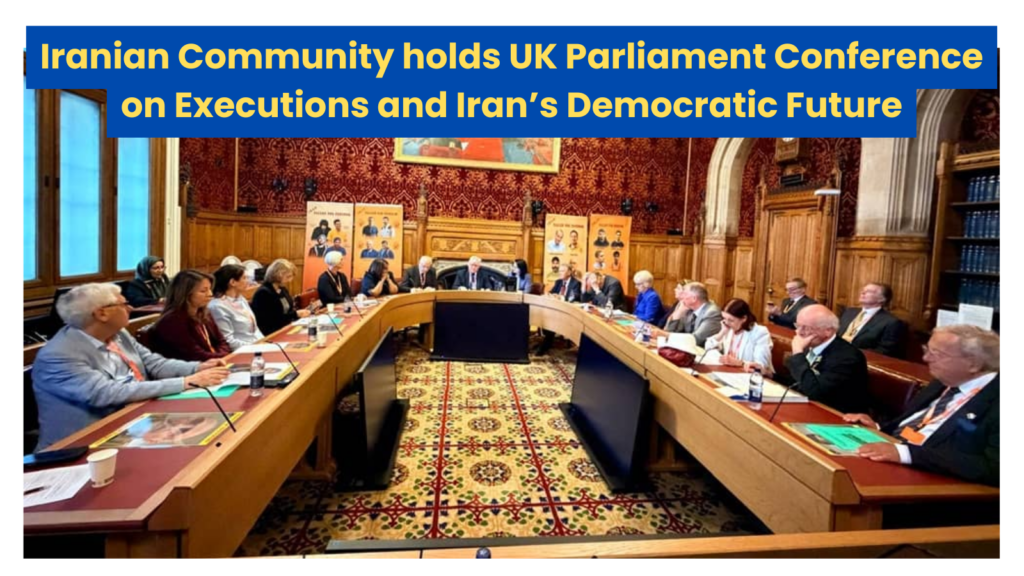
London, UK — April 28, 2026: Iranian community members and their supporters brought together British parliamentarians, legal experts, and human rights advocates at the Palace of Westminster for a conference focused on executions, human rights violations, and the future of Iran.
The conference, titled “Iran: Towards Peace and Freedom,” provided a platform for participants to raise concerns about the increasing use of executions against political prisoners and protesters in Iran and to discuss the Iranian people’s demand for democratic change.
The event was attended by members of the UK Parliament, human rights lawyers, civil society representatives, and members of the Iranian community. Speakers called for stronger international action in response to executions and repression in Iran and emphasized the importance of supporting the Iranian people’s right to determine their own future.
Azadeh Zabeti, co-chair of the Committee of Anglo-Iranian Lawyers, opened the meeting by highlighting Iran’s escalating human rights crisis and the sharp rise in executions. She criticized those now seeking recognition for work carried out by long-standing human rights campaigners, saying: “It is absolutely repugnant that individuals who have been asleep for the near five decades that the Iranian regime has carried out such savage attacks… are now trying to take credit for the work of this committee.”
Several British parliamentarians addressed the human rights situation in Iran and expressed support for ending executions and strengthening international accountability.
Sammy Wilson MP spoke about the execution of young protesters and emphasized that political change should not lead to another dictatorship.
Jim Shannon MP, Chair of the APPG for International Freedom of Religion or Belief, highlighted the situation of women facing execution and called for action against the IRGC.
Lord Empey paid tribute to activists who have maintained a constant presence outside Parliament. He linked the rise in executions to the regime’s fear of dissent, saying, “What they are doing is an expression of fear. They are afraid of young men like this.” He called for a stronger UK policy, including expelling Iranian diplomats and banning the IRGC.
Bob Blackman MP stressed that change in Iran must come from the Iranian people, not foreign powers: “To change the regime in Iran is not going to be done from the air… It’s got to be done by the Iranian people themselves.” He paid tribute to those resisting the regime inside Iran and rejected reliance on Reza Pahlavi, stating there “should be no dealings with the son of the Shah.”
Blackman urged the UK to support Maryam Rajavi, the NCRI and the PMOI/MEK, praising her Ten-Point Plan and its commitment to free elections within six months of regime change. He also called for the IRGC to be proscribed in its entirety, concluding with support for a free and democratic Iran led by its people.
Christina Blacklaws, former President of the Law Society of England and Wales, described the Iranian judiciary as an instrument of repression and called for international accountability for serious human rights violations.
Lord Alton of Liverpool also spoke about executions and transnational repression and called for human rights to be made a central consideration in international engagement with Iran.
Other speakers focused on accountability and the need to address Iran’s judicial system.
The conference also addressed the question of Iran’s political future. Speakers discussed a transition based on the Iranian people’s participation, rejection of dictatorship, and the establishment of democratic institutions. The NCRI’s Ten-Point Plan was presented by several participants as a proposed framework for a future Iran, including commitments to free elections, separation of religion and state, equality between women and men, and the abolition of the death penalty.
Lord Steve McCabe said the Ten-Point Plan could “bring about meaningful change” and enable a “peaceful transfer of power” led by the Iranian people.
Lord Hamilton of Epsom described the regime’s executions as “nothing short of murder,” stressing the need to confront the power of the IRGC.
Baroness Redfern highlighted the Ten-Point Plan as a framework “free from foreign intervention,” while calling for an end to executions and the protection of political prisoners.
Dr. Leyla Hannbeck described the NCRI as “a democratic platform designed to avoid such outcomes,” arguing that it provides a framework for an organized transition.
Baroness Verma concluded by assuring the Iranian community that parliamentarians would “never shy away from calling things out” and would continue supporting the call for a free and democratic Iran.
The event also highlighted the role of the Iranian diaspora in keeping international attention focused on human rights violations in Iran. Iranian community representatives thanked British parliamentarians and human rights advocates for their support and emphasized the importance of continued international attention to executions, political prisoners, and the Iranian people’s demand for democratic change.
For the Iranian community organizers and participants, the Westminster gathering provided an opportunity to bring the voices of Iranians facing repression to an international audience and to call for continued attention to executions, human rights violations, and the right of the Iranian people to determine their political future.