


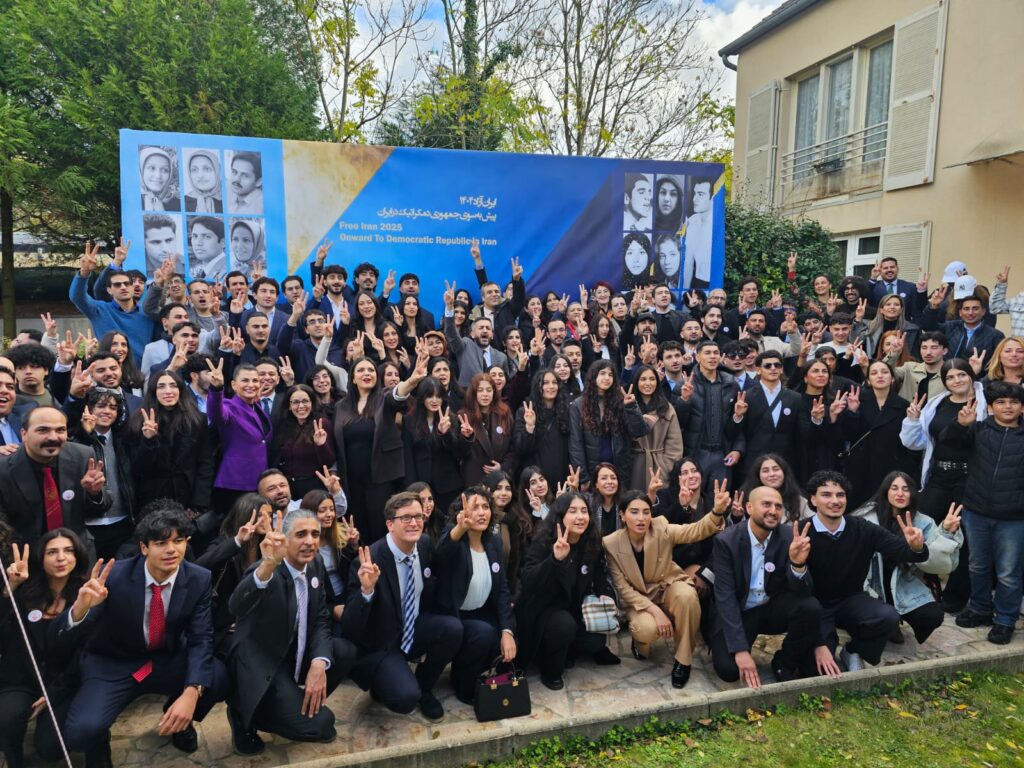
On Saturday, October 25, 2025, an eight-hour international youth gathering titled “Free Iran 2025” brought together young supporters of a free Iran from across Europe, the United States, Canada, and Australia. The meeting, held in Paris on the eve of the anniversary of Iran’s November 2019 uprising, was linked live to simultaneous youth assemblies in Bonn, London, and Zurich.
Over the course of the event, speakers from 32 youth associations — athletes, engineers and technical specialists, lawyers and legal experts, doctors and medical staff, students, academics, researchers, families of slain activists, and young participants in the 2019 and 2022 protests inside Iran — took the floor.
Speakers repeatedly framed that alternative as a secular, democratic republic. A representative of young legal professionals, Mahan Taraj, said Iran’s current judiciary “is itself the embodiment of injustice,” accusing it of using religion to justify torture, executions, and censorship.
The generational dimension — and the cost paid by families over decades — was one of the central themes.
Several speakers introduced themselves through the losses in their families.
Negar Safa, a 22-year-old medical student, spoke as part of the “Families of Martyrs” delegation. She described her uncle, arrested in 1981 and later executed in 1988 in Gohardasht Prison. She recalled the mass executions of some 30,000 political prisoners in the summer of 1988 and said that even today there is “no grave” for many of them. “Even if you build a parking lot over their mass graves,” she said to the regime, “we will not forgive and we will not forget.”
Elham Sajedian, who holds a master’s degree in geology from Shiraz University and now lives in Switzerland, said her father, Mohammad Sajedian, was imprisoned under both the Shah and the clerical regime and executed at age 34. According to her account, authorities have tried to prevent families from even engraving names on headstones. She called the abolition of the death penalty “the cure for the wounds left on a whole generation that grew up without a father or mother.”
From Shiraz, Abdollah Bazrafkan described the street confrontations during November 2019 and again in 2022. He said crowds chanted “No Shah, no Supreme Leader” and “Death to the dictator” while teams of security forces “charged at even small groups of protesters.” According to his account, some neighborhoods managed to hold off authorities for hours. He said regime officials themselves admitted they had come “to the edge of collapse,” and he argued that “Iran is not the personal property of a turbaned or a crowned dictator.”
The economic cost of repression and militarization was another focus.
Ali Bagheri, university researcher in Brussels, said that in a country he described as one of the world’s top holders of oil, gas, and mineral reserves, energy shortages and infrastructure breakdowns are not “mismanagement” but “a structural looting.” He accused the regime of diverting “2,000 billion dollars from people’s pockets” into nuclear activities and regional militias. He cited what he called basic performance figures: power plant efficiency “below 38 percent” compared with “above 45 percent” in international benchmarks; and roughly “20 percent” of the country’s gas production lost in transmission and waste. He said Iran has “300 sunny days a year,” but that less than one percent of the grid comes from solar energy, compared to “15 percent in Turkey.” For him, this shows that “the country’s resources are being spent on repression, not on the people.”
Medical professionals described a collapsing health system.
A young doctor, Samira Ardalan, said many Iranians are effectively locked out of healthcare due to “a 46 percent hike in service costs” and what she called a lack of national coverage. She pointed to an admission by a former senior official that around 700,000 people in Iran had died of COVID-19 by the end of the previous administration. She honored medical workers such as “Dr. Aida Rostami,” described as having been killed “for treating wounded protesters in 2022,” and pledged that “no citizen should be denied treatment, medicine, or basic care.”
Engineer Behrouz Maqsoudi, representing the delegation of Iranian engineers and professionals, condemned the regime’s systematic destruction of Iran’s economic and industrial capacity. He said that while Iranian engineers abroad are among the most skilled and innovative in Europe, the regime at home “jails inventors, executes the gifted, and turns a nation of builders into a nation of survivors.” Maqsoudi pointed to the plunder of Iran’s natural resources and the misuse of oil revenues for military repression instead of national development. He added that the future democratic Iran envisioned by the Resistance would prioritize investment in science, infrastructure, and renewable energy, harnessing the talents of the younger generation to rebuild the country.
Other speakers focused on what they called the deliberate suffocation of talent.
Hanifeh Khayyeri, vice president of a Swedish research institute and an adviser on innovation policy for European institutions, said Iran is “not building a society, it is only trying to keep the regime alive.” She argued that instead of investing in researchers and specialists, the authorities “arrest the gifted, execute the brilliant, and hang talent from the gallows.” She said those who live abroad “have a responsibility to act as the voice” of the Resistance Units inside Iran and to “make their capacity visible and undeniable.”
Elaheh Mossadegh, a pharmacy student in Sweden, said her generation had “risen from the ashes of repression” and now regarded resistance as “a responsibility, not merely a hope.” Citing imprisoned students inside Iran, she vowed that youth abroad would “not lay down the banner of freedom until Iran is free.”