


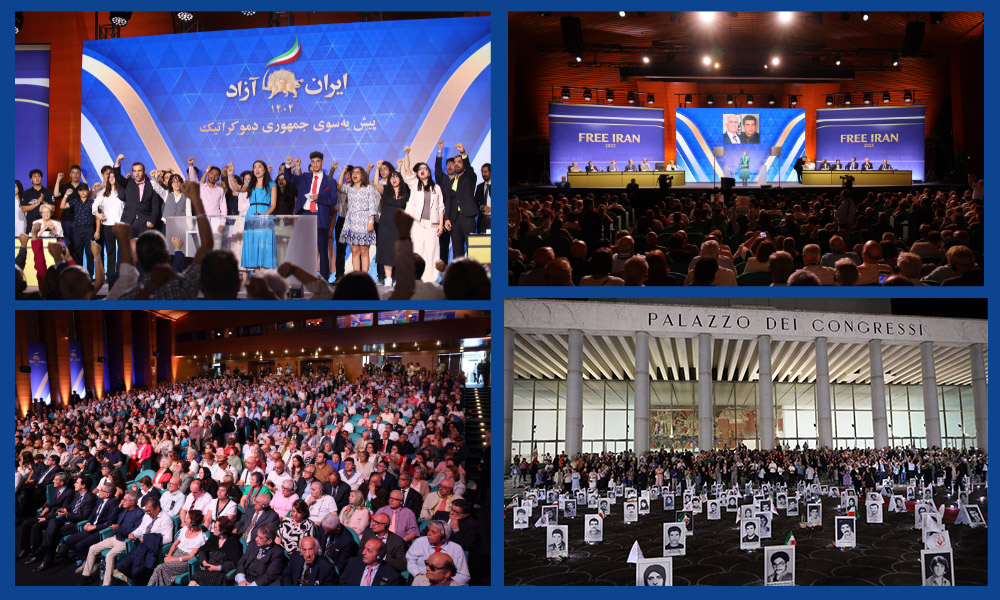
On 31 July 2025 the Free Iran Word Summit convened in Rome drawing global political leaders, lawmakers, human rights advocates, and Iranian expatriates in a unified call for regime change and the establishment of a democratic republic in Iran. Among the prominent figures attending were Charles Michel, former President of the European Council; Matteo Renzi, former Prime Minister of Italy; Michèle Alliot-Marie, France’s Foreign, Defense, Interior, and Justice Minister; James Cleverly, former UK Foreign Secretary and Home Secretary; Giulio Terzi Italian Senator and former Foreign Minister; Carlo Cottarelli, former Italian senator and economist; Rudy Giuliani, former Mayor of New York City; Ingrid Betancourt, former Colombian presidential candidate; U.S. Ambassadors Stephen Rapp and Carla Sands; Hans Ulrich Seidt Former German Ambassador; Senator Lucio Malan of Italy and Javaid Rehman, former UN Special Rapporteur on Iran, and representatives of Iranian communities across Italy.
Senator and former Italian Foreign Minister Giulio Terzi opened the conference. “Since its founding in 1979, the Iranian regime has been a terrorist state that uses executions as a tool of repression. The year 1988 marked one of the darkest chapters in the history of Iran and humanity. The time has come for justice to finally be served. The IRGC must be immediately blacklisted; this regime should have no place in the international community. The third option is the only viable solution for Iran: neither Shah nor Sheikh; change must come from the Iranian people’s resistance. Aligning with the regime is a betrayal of human rights. Our only demand is that no one should stand with this regime,” he said.
He praised Maryam Rajavi’s leadership and revealed that over 4,000 lawmakers worldwide now back the NCRI’s cause, a “global call for freedom.”
🇮🇹 Italian Senator & former FM @GiulioTerzi: “There is a clear alternative to the mullahs—it is here.” He urged Europe to end appeasement & blacklist the IRGC, backing Maryam Rajavi’s leadership and the NCRI’s democratic vision supported by 4,000+ lawmakers worldwide. @ItalyMFA… pic.twitter.com/aCcoclLaJD
— APA-ICE (@APA_ICE) August 2, 2025
In her keynote speech, Maryam Rajavi, President-elect of the National Council of Resistance of Iran (NCRI), delivered a stirring message of hope and transformation. She declared, “Today, our country stands on the threshold of a profound transformation. This change is being shaped by the people of Iran and their resistance—a nationwide movement that, through the highest sacrifices, including 100,000 martyrs, and with a clear roadmap and vision, heralds the dawn of a democratic republic in Iran.”
Rajavi emphasized that the Iranian people’s resistance is not merely a reaction to tyranny but a proactive force for democratic renewal. “This movement has been knocked down time and again,” she said, “but like the phoenix, it has always risen from its own ashes.”
She condemned both the former monarchical dictatorship and the current theocracy, stating, “Now, after decades of immense suffering endured by the Iranian people—marked by executions, massacres, and even acts of genocide—remnants of the Shah’s regime have seized the opportunity, believing that, as the religious dictatorship nears its end, the mantle of tyranny can be passed back to the monarchy. This is precisely why the Shah’s son is desperately seeking out the regime’s Revolutionary Guards,” Mrs. Rajavi said, adding, “We are confronted with a historical paradox: from the Shah to Sheikh, and now, from the Sheikh back to the Shah. But the reality is that the march of time does not allow a return to the past. No one goes back to yesterday. That is why tomorrow belongs to us, and we belong to tomorrow.
NCRI President-elect underscored, “From day one of drafting its constitution, the NCRI has called for a new republic—not a return to the dictatorships of the Shah or the Sheikh, nor their cosmetic reforms or rebranding under any guise…. It has drawn a clear line between itself and both the Shah and the Sheikh as both stood worlds apart from democracy and the Iranian people have experienced both over a century.
Rajavi laid out the NCRI’s plan for a peaceful transition to democracy, including the formation of a provisional government, elections within six months, and a constituent assembly to draft a new constitution. She reaffirmed the movement’s commitment to secular governance, gender equality, ethnic autonomy, and peaceful relations with neighboring countries.
The next speaker, former EU Council President Charles Michel said, “The spirit of resistance in Iran—resonating from the streets to the villages, from Ashraf-3 to across the globe—is louder and stronger than ever. Silence only emboldens the criminals, yet you still raise your voices because you will not surrender. The clerical regime fears you because it knows you are organized, credible, and represent the future. We cannot be intimidated, nor can we pay ransom…. This is not about foreign intervention; it is about supporting the Iranian people’s right to self-determination…. The women of Iran are the driving force of change in Iran, and I deeply respect your leadership, perseverance, and integrity—as well as that of Mrs. Maryam Rajavi. The Ten-Point Plan charts a clear path from dictatorship to democracy: for equality, justice, a non-nuclear Iran, and peace with its neighbors.”
Praising the NCRI’s #FreeIran10PointPlan as a blueprint for democracy, @CharlesMichel former Belgian PM & President of the European Council said at the Free Iran World Summit in Rome:
“From tyranny to democracy, your Ten-Point Plan is an oath for a democratic republic where… pic.twitter.com/w9fsv4AB1e— APA-ICE (@APA_ICE) August 2, 2025
Voices from Italian Leaders
Former Italian Prime Minister Matteo Renzi was next. “I want to also honor Mehdi Hassani and Behrouz Ehsani because they died for you, for us, for a free Iran. The only way is regime change by the Iranian people. Now we understand how weak this regime is now, the Ayatollah is afraid, he knows this time is over. Many people have been killed by this regime This is the time for justice, this is time for democracy, this is time for a free Iran,” he underscored.
Former Italian PM @matteorenzi said: “The only way is regime change by the Iranian people and their organized Resistance. This is the most difficult way, but it is the only way,” adding, “The message of democracy is in Maryam Rajavi’s Ten-Point Plan.” #IranThirdOption… pic.twitter.com/hVbDZ3wsF2
— APA-ICE (@APA_ICE) August 3, 2025
Senator Lucio Malan noted that Mrs. Rajavi not only inspires the Iranian patriots, but all those who love freedom. “We must be thankful to Mrs. Rajavi and all of you who support her in your endeavors with consistency for freedom in In Iran and even here in Europe, where you put your lives at risk. Regime change is necessary because the mullahs support terrorism and act against the welfare of the Iranian people. The regime’s influence has brought war, destruction to the region, and inside Iran, it has brought suppression to the people of Iran and to the woman of Iran. We support the 10-point plan, which can be supported by anyone who supports freedom and democracy. We must be grateful to those who gave their lives for freedom in Iran.”
Italian Senator @LucioMalan calls Maryam Rajavi “an inspiration for all who love freedom,” adding: “Protecting those who want freedom in Iran protects international peace.” He praised the NCRI’s #FreeIran10PointPlan as a universal platform for democracy and equality.… pic.twitter.com/Rb8UvfXQRn
— APA-ICE (@APA_ICE) August 3, 2025
Carlo Cottarelli, former Italian Senator and Economist, linked Iran’s political tyranny to its economic failures, noting: “Iran could be one of the richest countries in the world if managed properly. There is no hope for prosperity under this theocratic regime.”
He stated that only regime change led by the Iranian people could resolve both the nuclear threat and the country’s suffering: “External attacks may slow enrichment temporarily, but the only permanent solution is ending half a century of dictatorship.” Cottarelli endorsed Maryam Rajavi’s Ten-Point Plan as an “excellent blueprint for a democratic republic,” predicting that “the day we meet in a free Tehran is not far.”
Prominent Italian economist @CarloCottarelli said the international community shouldn’t just stand by, recognizing #NCRIAlternative is crucial.
“#FreeIran10PointPlan of Maryam Rajavi shows what Iran should be, which I fully support. The moment of change is not far.”… pic.twitter.com/VCS81ANC1n— APA-ICE (@APA_ICE) August 3, 2025
International Dignitaries in Solidarity
In part of her remarks, Michèle Alliot-Marie, former French Minister of Interior, Defense, Foreign Affairs and Justice stressed, “Only the Iranian people can decide about their future, they can build a government which they can trust in by free election. Madame President I know your program, and you have lost thousands of your friends, I have been in Ashraf-3. Madame Rajavi has said it already, where is a hope, there is a way.”
Former French minister @MAlliotMarie urged democracies to abandon illusions at Free Iran World Summit in Italy: “No military solution, but complacency is worse. Only Iranians can decide their future through free elections, a vision Maryam Rajavi leads with clarity and courage.”… pic.twitter.com/JhkeKaJ9Ps
— APA-ICE (@APA_ICE) August 3, 2025
Referring to the son of the deposed Shah of Iran, former New York Mayor Rudy Giuliani said, “This man has done nothing, so, he should not even run a sanitation company. Given all the contact he has with the Revolutionary Guards, that could be a crime. You are not allowed to have ties with IRGC, they are a terrorist group. Reza Pahlavi is a traitor to the people of Iran. You will get to a free Iran because the MEK is the only one they have the courage for that. How can we overthrow Khamenei? The MEK is very well represented inside Iran. You are going to back freedom to Iran. Freedom, democracy, and all the contributions Iran has made to history.”
.@RudyGiuliani praised the steadfastness of the Iranian resistance, concluding confidently: “It won’t be much longer. Everything is in place. The MEK will bring freedom to Iran, because you are the only ones who have stayed the course.” #No2ShahNo2Mullahs #FreeIran2025 @SebGorka… pic.twitter.com/SsRG4RJAwo
— APA-ICE (@APA_ICE) August 3, 2025
Former British Foreign Secretary James Cleverly said the international community wants freedom, prosperity, and peace for the Iranian people and that these things cannot and must not be forced upon the Iranian people from abroad. He said that change must come from within Iran and that he admires the Iranian people, especially women, for demonstrating courage and risking their lives for freedom.
Former UK Foreign Secretary @JamesCleverly: “What we want from Iran is freedom and prosperity. Leadership imposed from abroad cannot provide a lasting solution. It must come from the people and be accountable to them.”
A clear message on Iran: the future lies with its people.… pic.twitter.com/veTAL5nxYB— APA-ICE (@APA_ICE) August 3, 2025
Ingrid Betancourt, former Colombian Senator and Presidential Candidate, spoke of her personal journey discovering the truth about the PMOI, recalling a smear campaign meant to silence her after she defended them: “This campaign of demonization wasn’t rooted in facts but in fear—fear of a movement that is a credible alternative to tyranny.”
She identified six reasons why Tehran fears the PMOI: its disciplined structure, Maryam Rajavi’s revolutionary leadership, a democratic program with the Ten-Point Plan, a vast network of Resistance Units inside Iran, a legacy of 60 years of struggle, and unparalleled sacrifice: “This is not a movement for profit or power. It is a grassroots force willing to pay the ultimate price for freedom.”
.@IBetancourtCol “The PMOI is not just an option, it is the only option. A grassroots force, not for profit or power, but willing to pay the ultimate price for freedom. The free world must embrace this mission now.”
She exposed the smear campaign against the PMOI: “It wasn’t… pic.twitter.com/80G8aR3CGU— APA-ICE (@APA_ICE) August 3, 2025
Carla Sands, former US Ambassador to Denmark, praised the NCRI and MEK for building a clear roadmap: “They have an extensive network of Resistance Units risking their lives under repression. Their Ten-Point Plan promises freedom of speech, gender equality, separation of religion and state, and a non-nuclear Iran seeking peace.”
Amb. Sands emphasized that the international community must stop accommodating the regime: “Those who resist regime change are advocating for the mullahs and their global terrorism. The time is now to support the Iranian people’s right to self-determination.”
Former 🇺🇸Amb. to 🇩🇰 @CarlaHSands urges world leaders to end silence and stop accommodating Tehran:
“Those who resist regime change are advocating for the mullahs and their global terrorism. The time is now to support the Iranian people’s right to self-determination.”… pic.twitter.com/lg0spDsFjQ— APA-ICE (@APA_ICE) August 3, 2025
Linda Chavez, former Director of the White House Office of Public Liaison, highlighted the urgency of regime change: “Destroying bombs is not enough. Killing a few leaders is not enough. What must happen is regime change, and it must happen now, by the Iranian people.”
She dismissed the Shah’s heir as illegitimate, saying: “There are not people in Iran asking for the Shah back. We do not want more torture chambers under another dictator. The only alternative is a movement that has existed for sixty years and a leader who believes in fundamental human rights: Maryam Rajavi.”
Former Director of the White House Office of Public Liaison @chavezlinda dismissed the Shah’s heir as illegitimate: “Iranians aren’t asking for the Shah back. We don’t want new torture chambers under another dictator. The only alternative is the 60-year movement led by Maryam… pic.twitter.com/6p9v6UwXeD
— APA-ICE (@APA_ICE) August 3, 2025
Hans Ulrich Seidt, former German Ambassador to Afghanistan, analyzed Tehran’s weakening position, noting its “existential and possibly final crisis.” He stated: “Traumatic events in Iran can no longer be ruled out. The regime’s economic decline, social unrest, and loss of regional power point to its end.”
He emphasized that only the NCRI and PMOI present a credible alternative: “Some still believe reformers within the regime can bring change, but this only stabilizes tyranny. The PMOI is the force the regime fears most, and Resistance Units are breaking the wall of resignation. Your hope is not unrealistic.”
Warnings of a Looming Massacre
Dr. Javaid Rehman, former UN Special Rapporteur on Human Rights in Iran sent a video message to the summit. Dr. Rehman delivered a chilling warning that Tehran is preparing another mass killing of political prisoners: “On July 7, a state-affiliated outlet openly called for repeating the 1988 massacre. There are real fears of mass executions today.”
“The regime has weaponized the death penalty to exterminate dissent. The international community failed to act in 1988. It must not fail again.”
Ambassador Stephen Rapp, former US Ambassador-at-Large for Global Criminal Justice, delivered a stark message on the scale of repression in Iran and called for a coordinated global effort to ensure accountability for Tehran’s atrocities: “We must gather evidence, identify perpetrators, and ensure they face justice wherever they set foot. The world cannot again turn a blind eye as it did in 1988, nor trade away justice for hollow promises on nuclear talks.” He assured Iranian victims and their families: “The day of justice will arrive for Iran. Just as tribunals brought war criminals in Rwanda and Bosnia to account, the architects of mass killings in Tehran will one day face their victims in court.”
Stephen Rapp, US Ambassador at Large for Global Criminal Justice said in the presence of Maryam Rajavi “I see the future of a free Iran. I’m ready to work with you to achieve change, a democratic future with justice, where those who committed these crimes are held to account.”
He… pic.twitter.com/DPMrpGaYfE— APA-ICE (@APA_ICE) August 3, 2025