


Condemning the Death Sentences for Behrouz Ehsani and Mehdi Hassani, Transferred to Ghezel Hesar and Facing Imminent Execution
The New York City Bar Association (“City Bar”) expresses grave concern over the death sentences imposed on Behrouz Ehsani and Mehdi Hassani by the Islamic Republic of Iran. These sentences, handed down in connection with their peaceful activism and alleged affiliation with the People’s Mojahedin Organization of Iran (PMOI), represent a blatant violation of international human rights law and underscore the Iranian government’s systematic suppression of dissent.[1] The City Bar is further alarmed by reports that Mr. Ehsani and Mr. Hassani have been transferred to Ghezel Hesar Prison and are now facing imminent execution.[2]
Background and Charges
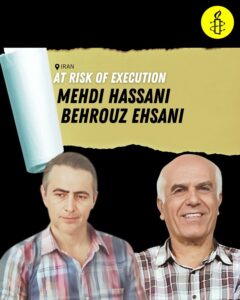
Behrouz Ehsani, a 69-year-old political prisoner, was arrested on December 6, 2022, in Tehran and transferred to Ward 209 of Evin Prison, where he was subjected to torture. He was previously held in Ward 4 of Evin Prison. Mehdi Hassani, a 48-year-old political prisoner, was arrested on September 11, 2022, in Zanjan and similarly transferred to Ward 209, where he endured physical and psychological torture. He was imprisoned in Ward 8 of Evin Prison.[3] Both individuals were charged with politically motivated offenses, including “rebellion (baghi),” “waging war against God (moharebeh),” and “spreading corruption on Earth,” as well as allegations of illegal weapons possession and possessing classified information.[4]
Mr. Ehsani and Mr. Hassani were active participants in the “No to Execution Tuesdays” campaign, a grassroots movement advocating against Iran’s excessive use of capital punishment. While detained, they wrote letters urging the international community to abolish the death penalty, highlighting the inhumane conditions they endured in Ward 209 of Evin Prison.[5]

Arrests, Sentencing, and Transfers
Following their initial detention in Ward 209, Mr. Hassani was moved to Ward 8 of Evin Prison, and Mr. Ehsani was held in solitary confinement in Ward 240 for three and a half months before being transferred to Ward 4.[6] On September 16, 2024, they were sentenced to death on charges widely regarded as politically motivated. Their sentences were confirmed on January 7, 2025.[7] Recent reports indicate that both men have been transferred to Ghezel Hesar Prison, a facility notorious for carrying out executions, and are now at imminent risk of execution.[8]
On January 11, 2025, 68 political prisoners in Iran issued a letter condemning the death sentences against Mr. Ehsani and Mr. Hassani, describing the death penalty as “state-sponsored premeditated murder” and noting that Iran accounts for nearly 75% of global executions in 2024.[9] The presiding judge, Judge Afshari of Branch 26 of the Tehran Revolutionary Court, has a well-documented history of imposing extreme sentences on political prisoners, including recent convictions of Pakhshan Azizi (2023), Saba Kordafshari (2019), and Seyed Abolhassan Montazer (2024).[10]
Systemic Due Process Violations
The cases of Mr. Ehsani and Mr. Hassani exemplify the Iranian government’s systemic denial of due process and fair trial guarantees. Political prisoners in Iran routinely face:
- Denial of legal counsel and fair trials; [11]
- Physical and psychological torture, including coerced confessions;[12]
- Prolonged solitary confinement and denial of medical care;[13]
- Summary trials resulting in flogging or the death penalty.[14]
Evin Prison, where both men were previously detained, is notorious for its inhumane conditions, including overcrowding, lack of hygiene, forced drugging, and inadequate nutrition. Political prisoners are often subjected to harsher treatment than other inmates.[15] Ghezel Hesar Prison, where they are now held, is equally notorious for its harsh conditions and frequent executions.[16]
Violations of International Law
The Iranian government’s actions violate numerous international legal standards, including:
- The International Covenant on Civil and Political Rights (ICCPR), particularly the prohibition of torture (Article 7), the right to liberty and security (Article 9), and the right to a fair trial (Article 14);[17]
- The Convention Against Torture (CAT), which reflects the peremptory norm of international law (jus cogens) prohibiting torture, even though Iran is not a party to the treaty;[18]
- The Universal Declaration of Human Rights (UDHR), including the right to freedom from torture (Article 5) and the right to a fair trial (Article 10);[19]
- The UN Standard Minimum Rules for the Treatment of Prisoners[20] and the UN Basic Principles on the Role of Lawyers, which guarantee humane treatment and access to legal representation.[21] [22]
The City Bar emphasizes that the right to dissent is a universal human right, enshrined in Article 19 of both the ICCPR and the UDHR. The Iranian government’s persecution of Mr. Ehsani and Mr. Hassani for their peaceful activism constitutes a flagrant violation of this right.[23]
Call to Action
The New York City Bar Association calls on the Iranian government to:
- Immediately halt the executions of Behrouz Ehsani and Mehdi Hassani, overturn their convictions, and release them unconditionally;
- End the criminalization of dissent and ensure all detainees have access to legal counsel, medical care, and humane treatment;
- Comply fully with international human rights laws, including the ICCPR and the Convention Against Torture.
The City Bar further urges the international community, including the United Nations and human rights organizations, to hold the Iranian government accountable for its egregious human rights violations and to take immediate action to prevent the execution of Mr. Ehsani and Mr. Hassani.