


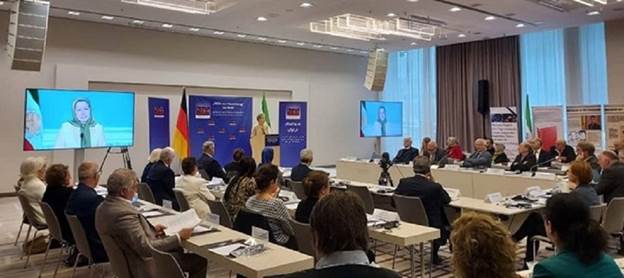
At a conference in Berlin, members of the German Bundestag and former government officials raised alarms about the unprecedented wave of executions in Iran. They criticized the prevailing culture of impunity and called for the establishment of special tribunals to hold the leaders of the Iranian regime accountable for systematic human rights violations.
The conference was organized by the German section of the Alliance for Public Awareness (APA) in cooperation with the German Solidarity Committee for a Free Iran (DSFI), a coalition of former and current politicians and human rights activists in Germany.
According to reports, since August, following the inauguration of Masoud Pezeshkian as president of the mullahs’ regime, at least 191 prisoners, including women and political prisoners, have been executed. Amnesty International has reported that 74% of all executions recorded worldwide in 2023 occurred in Iran. This trend has worsened under the new government.
In 1988, on the orders of Ruhollah Khomeini, the founder of Iran’s theocratic rule, 30,000 political prisoners, 90% of whom were members and activists of the main resistance movement, the People’s Mojahedin Organization of Iran (PMOI/MEK), were massacred within a few months.
In a report on July 24, 2024, Professor Javaid Rehman described this as “crimes against humanity” and “genocide.” He emphasized that many of those involved in these crimes continue to enjoy official government privileges and remain untouched by international justice and accountability.”
Maryam Rajavi, the president-elect of the National Council of Resistance of Iran (NCRI), addressed the conference via zoom.
Other speakers included Prof. Dr. Herta Däubler-Gmelin, Federal Minister of Justice (1998-2002); Carsten Müller, member of the Bundestag; Dr. Franz Josef Jung, Federal Minister of Defense (2005-2009); Prof. Dr. Wolfgang Schomburg, Judge at the International Criminal Tribunal for the former Yugoslavia (ICTY) (2001-2008) and former Judge at the UN Criminal Tribunal for Rwanda (ICTR); Günter Nooke, former member of the Bundestag and former Federal Government Commissioner for Human Rights and Humanitarian Assistance; Ambassador Dr. Joachim Rücker, former president of the UN Human Rights Council; Martin Patzelt, former member of the Bundestag; Ingrid Betancourt, Colombian presidential candidate; and Detlef Wagner, deputy mayor of Charlottenburg-Wilmersdorf in Berlin.
Several hundred German-Iranians and some representatives of the German-Iranian community in Germany attended the conference, including former political prisoners and family members of those executed in Iran, who also spoke at the event. Participants included human rights activists and others interested in Iran and the Middle East.
The conference began with the acknowledgment of the urgent need to confront the reality of the Iranian regime’s repressive practices.


In her address, Maryam Rajavi outlined what she sees as the correct European policy towards the Iranian regime. “The Iranian people demand freedom and democracy, a republic based on the separation of religion and state, gender equality, autonomy for national minorities, and an Iran without executions and torture. Without a doubt, they will succeed.”
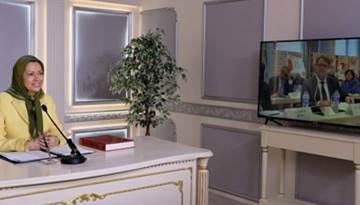

Mrs. Rajavi highlighted four essential measures that she believes reflect both the aspirations of the Iranian people and the needs for peace and stability in Europe: the designation of the Revolutionary Guards Corps (IRGC) and the Ministry of Intelligence as terrorist organizations, the closure of official and unofficial regime centers and the expulsion of its agents, the prosecution of regime officials for genocide, triggering the snapback mechanism in UN Security Council Resolution 2231 and reactivating previous Council resolutions against the regime’s nuclear projects, and recognizing the fight of Iranian youth and resistance units against the IRGC to abolish the religious dictatorship.


Regarding the human rights situation in Iran, she said, “It would be good if the report by UN Special Rapporteur Javaid Rehman were finally recognized by the German public and taken up by the German Bundestag for consideration. This report particularly highlights the role of the Iranian judiciary as an accomplice to massacres and atrocities, which has so far received far too little attention. From the death of Mrs. Amini to the 1988 massacre, the Iranian judiciary has failed to provide accountability and has imposed death sentences on political prisoners with vague justifications, thus serving as a crucial tool for the regime in its human rights violations,” she emphasized. She called on the international community to scrutinize the Iranian judiciary more closely.Former Defense Minister Dr. Franz Josef Jung warned in his speech against being deceived by the new president of the Iranian regime, Masoud Pezeshkian, and his public appearance. Instead of focusing on the individuals currently in power in the regime, the world should focus on the achievements of the Iranian resistance in its fight for freedom. “This resistance has a clear platform, and the Ten-Point Program of President Maryam Rajavi is presented. It is a program for establishing freedom, the rule of law, equality, and a secular and democratic republic capable of uniting the democratic forces and ethnic minorities in Iran.”







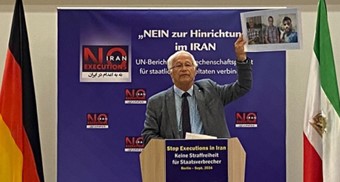

Human rights activist and former Bundestag member Martin Patzelt held up three photos of political prisoners currently sentenced to death and said, “In the past ten days, death sentences have been handed down to three political prisoners: Behrouz Ehsani, Mehdi Hassani, and Javad Vafaie. They are accused of supporting the main Iranian opposition movement, the MEK. Javad Vafaie is a boxing champion. His life is in immediate danger.”
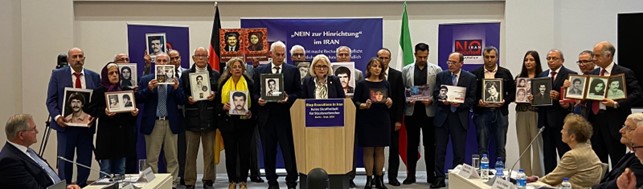

Ms. Vida Nik Tale’an, an activist and representative of the Iranian community in Hamburg, shared her experiences with the audience. Nik Tale’an described the pervasive atmosphere of fear and repression in Iran, explaining how torture, executions, and various forms of inhumane treatment have become a daily reality.
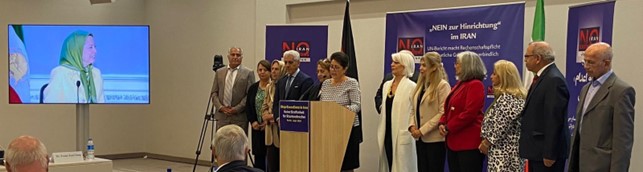

Another important voice was Akbar Bandali, who shared his story of 13 years of imprisonment and torture. Bandali’s experiences in Evin Prison, where he witnessed countless executions, illustrated the regime’s ruthless treatment of dissent. He provided harrowing details about mass executions and the psychological suffering of the prisoners. His account highlighted not only the personal impact of the regime’s brutality but also the need for accountability and justice.
Representatives from German-Iranian societies expressed their full support for President Maryam Rajavi’s Ten-Point Program.
Throughout the conference, the speakers emphasized the importance of raising global awareness about the actions of the Iranian regime. They underscored that the atrocities committed are not just local issues but affect the international community. The speakers called for a united front against human rights violations and urged individuals and organizations worldwide to advocate for change. They outlined a path forward, one based on the hope for justice, accountability, and ultimately, freedom.